Toothpaste Glass 161
Wednesday, January 17, 2007
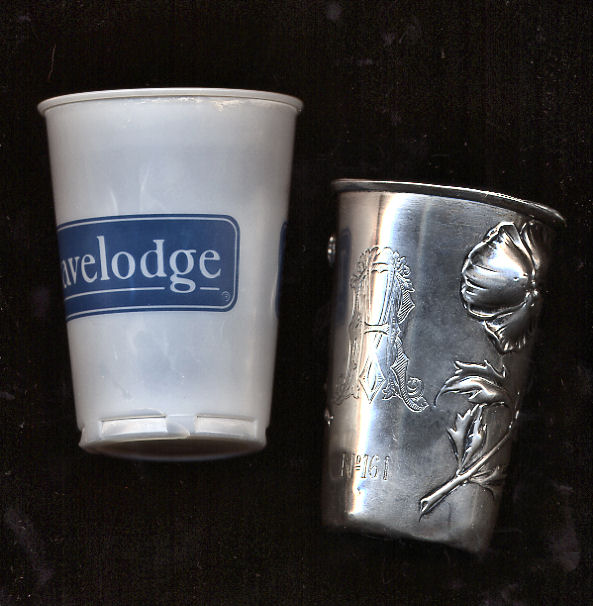
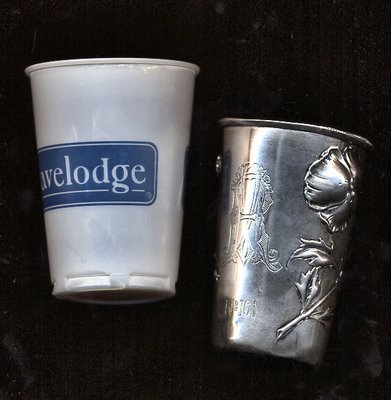 My maternal grandmother Lolita went to a boarding school for girls in Spain in the 19th century and was issued sterling silver cup No 161 to drink with her meals. I never asked her the name of the school or where in Spain her school was. I never asked her if all she drank out of it was water or how she polished it. By the mid 1950s the cup had been relegated to function as a toothpaste glass. We never ever called it a toothbrush glass. When I married Rosemary, she saw the sentimental value of cup 161 and insisted we display it with our collection of pocket watches and other family memorabilia. For 39 years we have had a varied assortment of toothpaste glasses. In our early years in Burnaby, our daughters borrowed them for mixing watercolours and Rosemary and I might have popped Eno or Alka Seltzer to fight stomach ailments. I hated the plastic glasses and the glass ones either looked perpetually dirty or they would fall and break. I was much too lazy to vacuum the glass splinters. Once I bled over our white sheets with a cut foot. I learned my lesson. In the last year we have been practical. In a recent trip to Mexico we stayed overnight in a Seattle Travelodge and Rosemay pinched half a dozen plastic water cups which have been splendid. Or so I thought. Rosemary's 15 year-old male cat, Toby, has always insisted in drinking his water from either the bathtub tap or the bathroom sink tap. Rosemary first tried leaving either taps running for a while. The water noise drove me nuts until I discovered that if I placed the Travelodge glass, full of water by the sink tap, Toby would climb up and happily drink from it. Must I share my toothpaste glass with a cat? Or could it be the appropriate time to bring back my grandmother's school glass?
King Solomon's Mine, Thumbs Down - Navigator, Thumbs Up
Tuesday, January 16, 2007
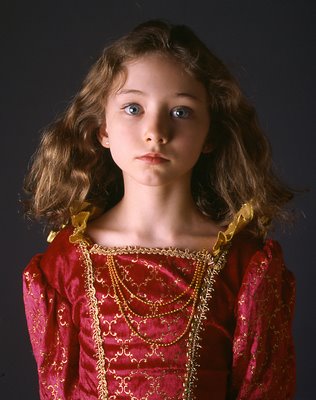
There is a keen enjoyment in deciding on a movie that I can watch on a Saturday with Rebecca who is 9. I want to replicate those rosy periods of my life when my father and mother or my grandmother took me to the movies. It is difficult because going to the movies with them involved the excitement of taking the train to Retiro in Buenos Aires and then connecting from there on the "subte" (subway) that would take us to Lavalle which was the station below the long street that was one movie house after another. In what they called "programa continuado" we would go into a movie, and see the middle of the movie, the beginning and then we would leave where we had arrived to go to another. We saw cowboy, pirate movies and even war movies. If Abuelita did not like these movies she was pretty good at hiding it. After the shows we would then go and sip on tall strawberry or chocolate ice cream sodas. My parents were a bit more discerning and took me to see movies they wanted to see. That is how I saw Beau Geste and most of the other Gary Cooper films. My mother loved Herbert Marshall, Joseph Cotton, Ronald Colman, Stewart Granger (she took me to Scaramouche, twice) and Leslie Howard. We saw as many Gene Tierney movies as came to Argentina, including my favourite ghost story movie, The Ghost and Mrs. Muir with Rex Harrison. But I was scared to death by Katherine Hepburn's pants and hated her movies. My guess is that the woman confused my early sexuality. One of the best moments was going to see Laura (with not only Gene Tierney but with Dana Andrews) with my father and mother. I could not help but notice that my father's trench coat was very similar to Andrews's. That could be why I have had a special fondness for all of Dana Andrews's movies ever since.
Seeing a film on our own TV, without having to go anywhere, is not quite the same thing. It means that if the movie does not interest Rebecca she can get up and go to the piano or out into the garden. And she has been quick to do that. I have to be very selective.
I have picked some good ones which have backfired on me. Rebecca nags me that she wants to see Tarzan of the Apes again. We enjoyed Gunga Din but Roman Holiday taxed her attention span. I was right that the special effects of the much more recent (1985) Young Sherlock Holmes would suck her into seeing it. I would not be surprised if she insists we see Scaramouche again.
On Saturday night I took out two film DVDs from Videomatica. One I thought was a sure bet. I picked the Deborah Kerr and Stewart Granger Technicolor King Solomon's Mines. As soon as the the two hunters in a safari shot two elephants, Granger's sympathetic and sensitive safari leadership was not enough to calm down Rebecca. But on a lark I took out my favourite time-travel film of all time, Navigator: A Medieval Odyssey. This 1988 Vincent Ward New Zealand (in co-production with Australia) has a fairly complicated plot. Rebecca (and Lauren, 4, was never bored), was transfixed by the b+w portions of the film that give the impression someone took a time machine into a 14th century Cumbria copper-mining village to film it. Once it ended Rebecca ran to my computer to Google "the plague". I read her the best description on how the plague started from Edward Rutherford's Sarum.
1348
On a warm August morning, a little after dawn, the small ship had passed the low headland and come slowly through the sheltered harbour waters to tie up beside the quay at Christchurch. The ship contained a cargo of wine, from the English province of Gascony in south west France. The sailors, eight bluff, healthy fellows came briskly down the gangplank and were welcomed by the men of the waterfront. Soon afterwards they began to unload.
They did not know about their passenger and his small companion.
Rebecca was shocked when Rutherford reveals the mysterious passenger to be a black rat and his companion a common flea.
Cocktails With George, Alex & The Wrestler Who Never Was
Monday, January 15, 2007
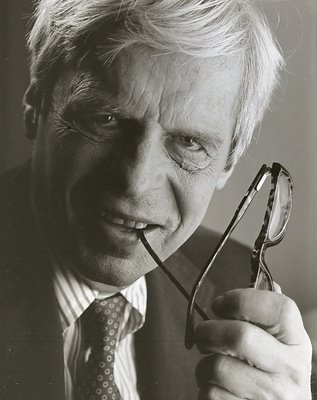
My friend John Lekich suggested that I keep on the drinking theme by writing about our mutual experience with George Plimpton at the Wedgewood Hotel on November 1990. I threw the suggestion back and told him, "You write it."
---------------------------------------------------------------
When Alex suggested that I reminisce about our professional encounter with the late George Plimpton back in the early nineties, I was delighted to oblige. Alex and I have collaborated on many articles over the years. But the founder of the famed Paris Review – a legendary editor, writer and raconteur who launched his distinguished career by interviewing Dorothy Parker – is the only subject who ever suggested that we indulge in a cocktail before noon.
True to his impeccable Ivy League breeding, Plimpton offered us first crack at the little bottles in the hotel mini-bar before indulging in his personal choice of a gin and tonic. I recall a distinct thrill at raising a glass in the company of a man who was one of the guests at Truman Capote’s famed Black and White Ball back in the sixties.
As the originator of “participatory journalism” – a form of reportage that saw the young and gangly Plimpton partake in everything from boxing with Archie Moore to playing goal for the Boston Bruins – Alex and I were startled to discover that his most terrifying professional experience was playing the triangle under the demanding baton of Leonard Bernstein. At the time, George was toying with the idea of managing a wrestler who limited his ringside banter exclusively to Shakespearean text. As an example, he mimed an overhead body slam and roared: “I am the grass! I cover all!” When I suggested that he was still spry enough to actually play the role of cultivated wrester, his eyes lit up with excitement. “Do you really think I could do it?” he asked.
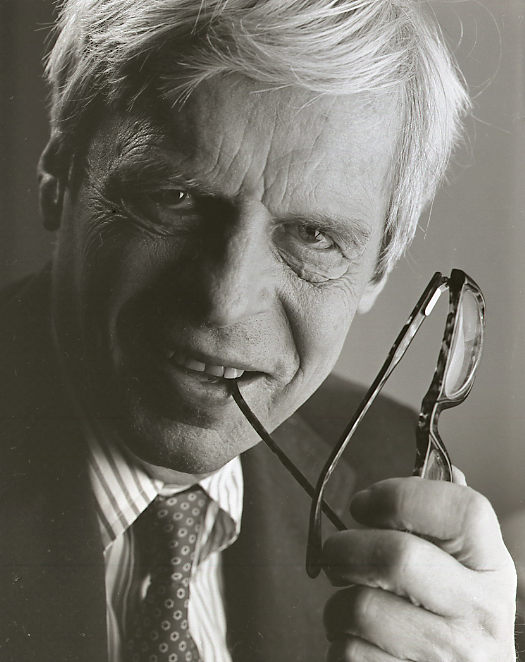
For the rest of our time together, George reclined on the bed and related intimate stories of his friendships with everyone from Hemingway to A.J. Liebling. He had that rare quality of being perfectly elegant and perfectly relaxed at the same time. When Alex suggested a portrait that involved Plimpton toying with the stem of his eyeglasses, his response proved that he was both a seasoned journalist and a true gentleman. “Of course,” he said. “I’ll do anything you’d like.”
A few years ago, I bumped into the publicist who shepherded him around town that day. “He couldn’t believe that you knew so much about who he really was,” she recalled. “You made him so very happy.” I went home, fixed myself a gin and tonic and thought of George.
Lord Gilbey Sips A Tio Pepe
Sunday, January 14, 2007
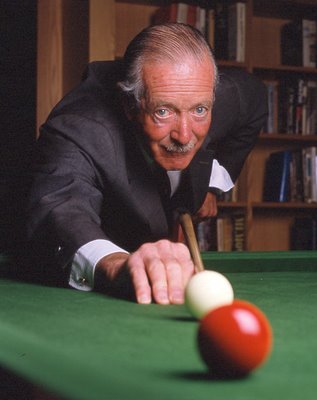
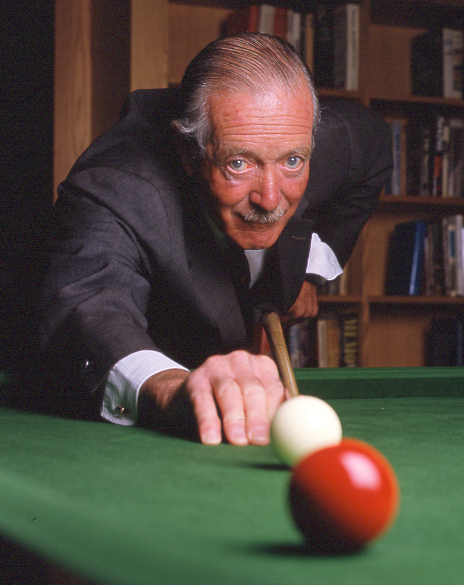
Sometime in early 1986 I arrived early to the billiard room of the Mandarin Hotel, the most luxurious hotel in Vancouver at the time. It is now the Metropolitan Hotel on Howe Street. I was there to take a portrait of:
The Honourable John Hugh Philip Gilbey, Lord Vaux of Harrowden. But he was also the unnoficial Ambassador of Gin.
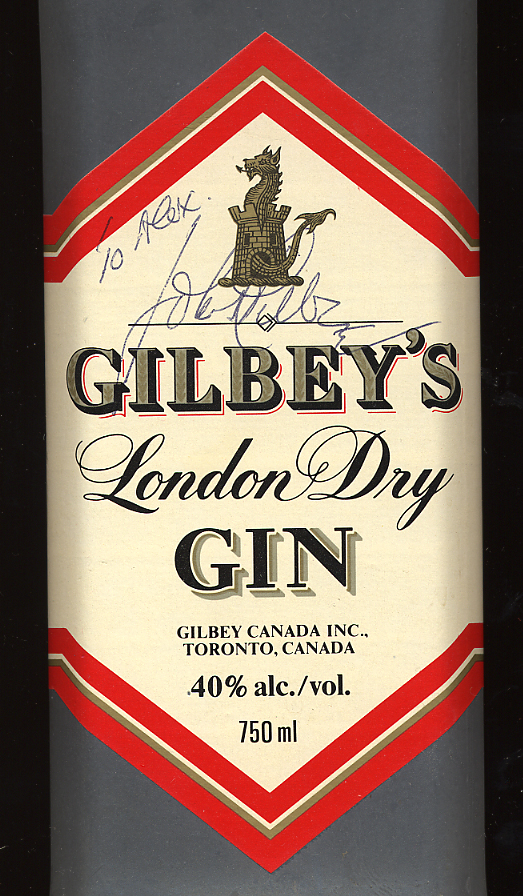
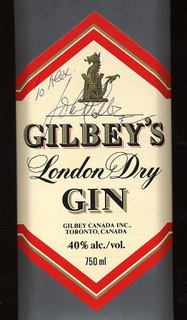
I set up my light on one side of the billiard table and my large camera on the tripod. I was ready for the man. When he arrived he looked at me and said, "Alex you have everything ready, I see, but you did not take into consideration that I am a southpaw." I did not see myself putting my light stand on the billiard table to light Sir John from his left. I thought about it for a few seconds; I removed my Hudson's Bay Harris Tweed jacket, placed it on the table and then the light stand on it. I took ten exposures. Sir John gave me a bottle of gin which he autographed first. I have never opened it.
In his talk with writer Garry Marchant, Sir John told Marchant that his favourite gin drink was as a summer drink, a gin and tonic. He called it a long drink. But he said that his favourite drink of all was a fine claret or a bottle of vintage port "If I was in a condemned cell and they said I could have a jolly nice bottle of wine with my last meal, I'd choose a bottle of vintage port."
During the interview, in his room, I noticed a bottle of Tio Pepe on his private bar. I asked him why he had it. I found out that Sir John was related by marriage to the Spanish Gonzalez Byass company that makes the very pale and very dry sherry, my favourite soup improver ( a shot in consommé is divine). I asked him if he had concoted some sort of drink that included Gilbey's Gin and Tio Pepe. With a big smile in his face (after having sung the Gilbey's Gin Song while accompanying himself on the piano, he had a piano in his room) he said, "Yes, it's called Primos Hermanos (first cousins) and you substitute Tio Pepe for the vermouth in a martini.
I decided to try the drink in the downstairs bar. I ordered it and the bartender put a disgusting look on his face. Without going into details I told him, "I have it from the horse's mouth that this is a fine drink." Since I am not much of a connoisseur, all I can say is that it adequately suited my needs for that afternoon.
In 1995, the hotel was no longer the Mandarin Hotel and the library had lost the billiard table. I was present during a long interview with Evelyn Hart. Like most men I fell for the swan.

After the interview and my photos I asked Evelyn if she would accompany me for a drink downstairs. She did. We had a couple of Primos Hermanos and I told her the story. She looked at me and said, "It's all right."
Having A Drink With Ernst Havemann
Saturday, January 13, 2007
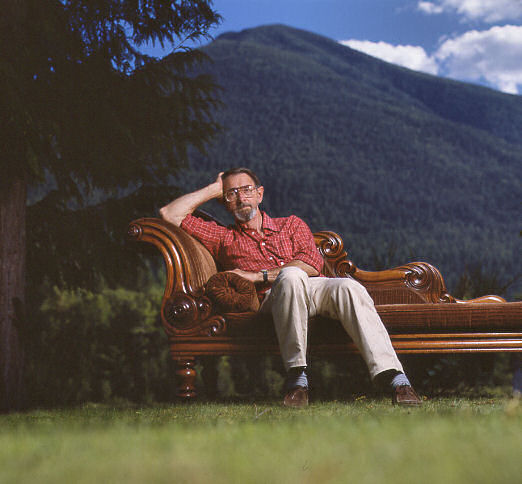
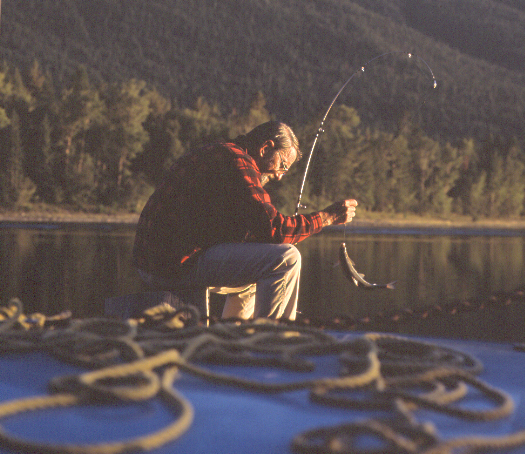
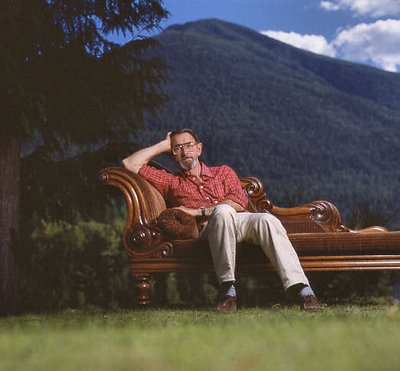 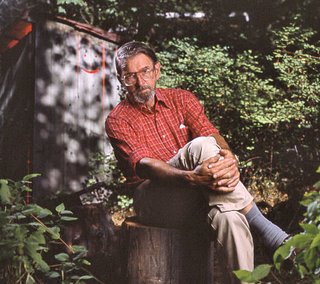 This blog and the next will pursue the theme of the previous one on drink. In 1987 good magazines published fiction. Saturday Night published fiction. For their April issue they dispatched me to Nelson to photograph an author I did not know anything about. He was a mining engineer who had been born in a farm in Zululand, South Africa in 1918. His first language was Zulu. After her retired he began to write. He had come to be known in Canada because he had won the CBC Fiction Prize four times. I arrived in my rented car from the airport, before noon and it almost became my undoing. The affable man told me I was going to stay for lunch and offered me a cocktail. During lunch we ate in a porch that overlooked Kootney Lake. The lake was right there and Havemann told me he liked to fish in his back yard. Lunch include several courses which were served with, "... this special white wine," and "...this superb red." Dessert came with port and and coffee was served with brandy and cigars. I was drunk. I photographed Havemann by his "pit privy". I loved how he pronounced it with a nasal twang. Then we carried the antique sofa outside and took his picture. He looked like a writer of the 19th century. When he suggested we have tea I was relieved. The tea would help me sober up. To my horror cold roast beef and egg sandwiches came with beer. There was no tea in sight. 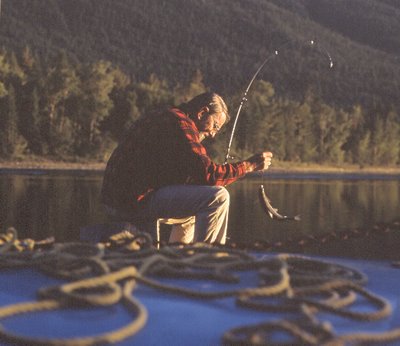 By the time I photographed Havemann pulling a fish from the lake (he had offered to do it with a confidence I had never seen in any other fishermen) I was having a problem setting up lights and moving around. I managed to finish. Havemann said, "Alex I think you should stay for dinner and fly out tomorrow." I thought of pre-dinner drinks, dinner drinks, dessert drinks and... so I politely declined and I somehow made it to the airport in one piece. As soon as I got home I purchased Havemenann's Bloodsong - And Other Stories of South Africa. It is one of my favourite books of short stories. Oddly, when Saturday Night published one of the stories, Tom and Beauty, they edited out the first two paragraphs. Here they are: We didn't have videos and peace movements in those days, so what we talked about where things like who made God, and should you tell your father if your mother was cheating on him.
Arabelle Jones's mother cheated when she went to dances, but Arabelle didn't tell her father: it would just make him more downtrodden. He was such a milktoast, he wouldn't do anything except perhaps desert her and her mother, and Arabelle would miss him. Mr Jones was rich.
The Rubáiyát & A Rubaiyyat - On Gin
Friday, January 12, 2007
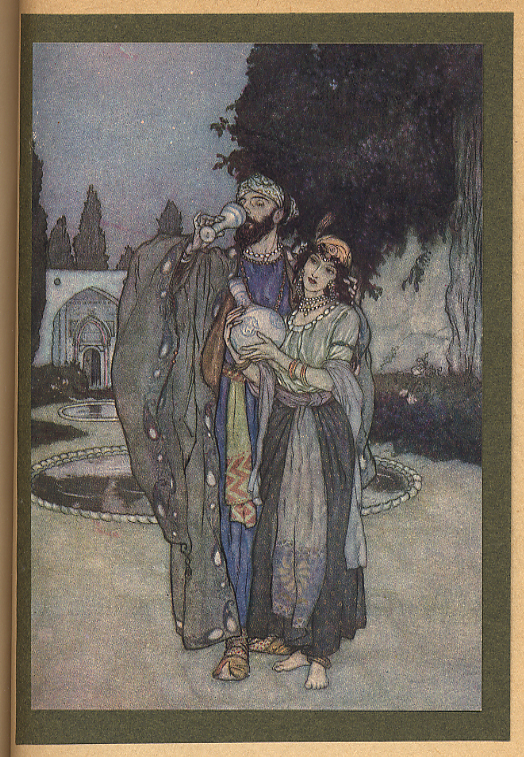
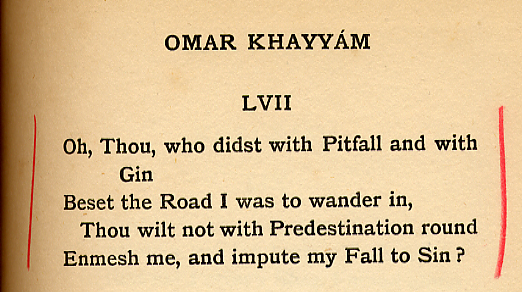
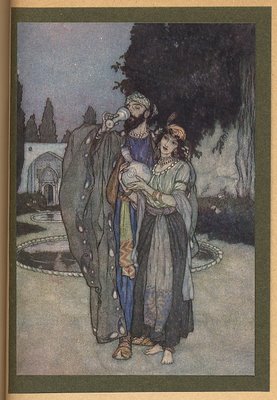 One of my mother's treasures was not a first edition of Omar Khayyám's Rubáiyát rendered into English by Edward Fitzgerald. She would have never been able to afford one. She had (and I inherited it) an early edition that incorporated Fitzgerald's first edition and his revised second edition. Noted illustrator Edmund Dulac did the fine illustrations which are pasted on to the this Hodder and Stoughton edition. My father had a fondness for gin. There were countless nights where I heard him promise my mother that he was going to stop. There was a particular quatrain (as the verses in the Rubáiyát are called), quatrain LVII of the first edition, that hit a chord with my mother. Perhaps she read it out loud to my father. I don't know. 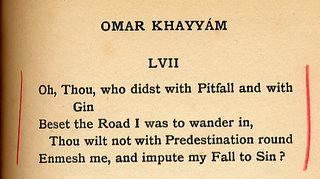 I do know that the page has two bold red pencil marks on either side. My mother died in 1972 and in 1973 I discovered a Penguin edition of the Rubaiyyat (note that the accents are now gone) that was listed as: A new translation with critical comments by Robert Graves and Omar Ali-Shaw (a noted Sufi poet and classical Persian scholar). It seems that my mother's beloved book had been a "transmogrification" (Fitzgerald's own word) of a 15th century Oxford manuscript. It was not not the earliest version of the famous Sufi work. An authorative 12-century version had been available to Sufic students in Afghanistan shortly after Khayaam's (note new spelling) death more that 830 years ago. I was startled to read side by side comparisons and I was upset to find out that Fitzgerald had even used Arab/English dictionaries in a straight literary meaning of the word fashion for his work. The real meanings of the quatrains in Graves's translation, while not having the aura of romance, had in some cases a completely different meaning. I wonder if this "true" edition might have pursuaded my father to quit his gin. My mother's marked quatrain LVII reads as follows in the Graves translation: I shall possess myself of a great goblet
With pipes of wine for its replenishment,
Annulling former ties to Faith and Reason
By marriage with this daughter of the Vine.Accurate or not my father might have replied from Fitzgerald's first edition, quatrain LXXI: And much as Wine has play'd the Infidel,
And robb'd me of my Robe of Honour-
well,
I often wonder what the Vinters buy
One half so precious as the Goods they
sell.
Gloria Macarenko & Cecilia Walters vs Shelagh Rogers's Mother
Thursday, January 11, 2007
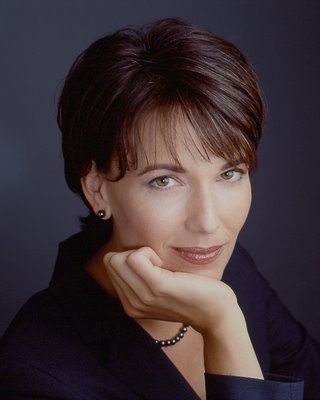
Be forewarned, if you read further, that I know little about television. My wife Rosemary and I limit ourselves to the Turner Classics Movies channel at 6:30 pm on Tuesdays for the Star of the Month series. This month we are thoroughly enjoying the films of Jean Arthur. While watching her it got me to thinking about CBC TV's Gloria Macarenko. There might not be any obvious connection unless you ever listened to Bill Richardson's fine CBC Radio program Bunny Watson, which like all good things had to go away. In that program Richardson showed how everything can be connected through association if you look hard enough. Jean Arthur was a forceful heroine who apparently in real life was absolutely terrified (unlike Katherine Hepburn as Bunny Watson) of appearing on a film set and fought nausea and worse. Yet she was so natural and wonderful.
There are forceful women in our media, particularly on CBC Radio, my radio station of choice. Mary Lou Finlay was one of my faves and Ana Maria Tramonti is growing on me. The most forceful of them all was Shelagh Rogers's ( Sounds Like Canada) mother who appeared on Rogers's show a few times. Her voice was stronger and her laugh louder than her daughter's. And of course there is the inimitable and wonderful Barbara Budd of As It Happens. Budd could make my granddaughter Lauren, 4, finish her Chicken a la Barbara (Lauren loathes it unless we call it paprika chicken) without any needed persuasion. On CBC radio, the women are women that are no-nonsense. They are intelligent. They matter to me. I would love to sit down for tea with any of them. I like them, I love them. But for TV, we Canadians ( at least here in Vancouver) choose a different kind of woman. She is not so forceful, she is more sensitive and there is some sort of Jean Arthur fragility and an almost hidden sadness that is masked by what seems to be an effortless performance. Two such women come to mind.
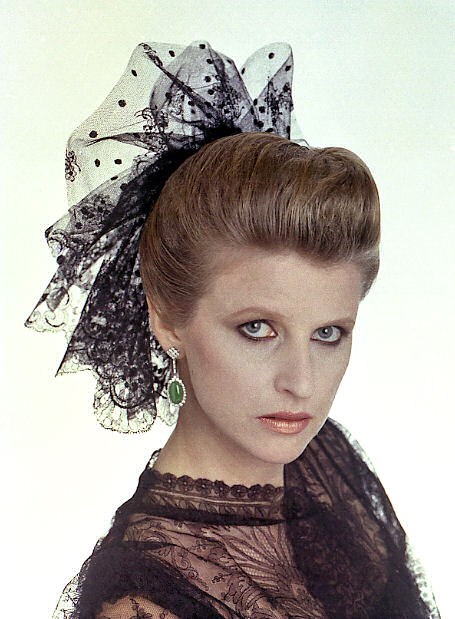
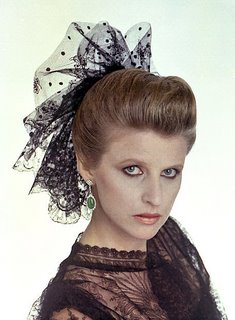
At 8:30 every weekday morning I get to hear Cecilia Walters (no speech impediment, no lisp, and a clean and crisp delivery) whom I met in the late 80s. She came to my studio for a photograph that accompanied a Vancouver Magazine profile. The magazine hired Sonny of Broadway to do her hair. I had my best makeup person and Tony Cavelti, escorted by an armed guard, brought the lovely emerald and diamonds ear rings you see in the picture here, above right. Perhaps we Canadians weren't as sophisticated then to appreciate a low key, sensitive (and intelligent) female TV news anchor and we would have settled for someone like CNN's Paula Zahn. The little I have seen of Paula Zahn reminds me of that scene in Butterfield 8 where Elizabeth Taylor drills and then grinds her stiletto high heel on Lawrence Harvey's shoe. Paula Zahn would probably have made it even more painful for Harvey.
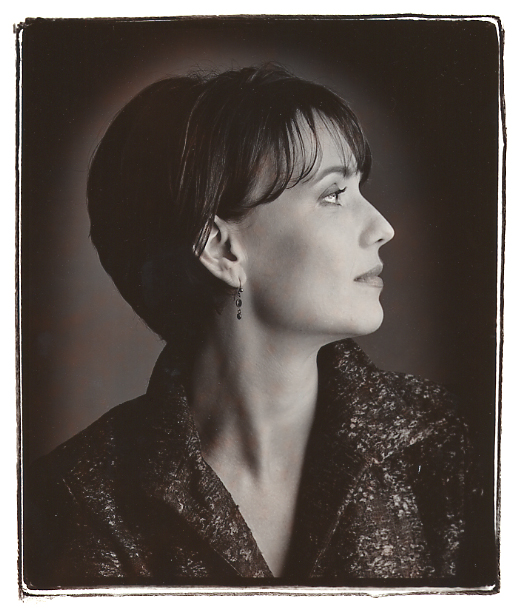
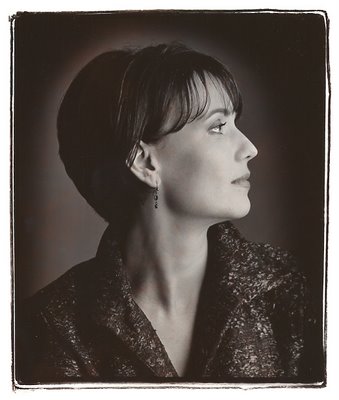
Since I prefer to read my news in my daily print edition of the New York Times at 6:30 am, I have seen little of Gloria Macarenko on TV. But I have seen enough to be charmed and drawn in. For news of Vancouver I listen to CBC radio. I have had the good fortune of having Macarenko in my studio a couple of times. I don't think any man in my place could feel any different than I felt when this woman looked into my lens and straight (it would seem) into my soul. Then she spoke to me in her perfect Castilian. Had I been a few years younger (this happened in 1999) I would have challenged her husband to a duel at 6am (with time to rush home to read the NY Times) in the back alley to Holy Rosary Cathedral. I subsequently met the charming Mr Enrique Manchon, who is a terrific photographer, socially at art openings and desisted from striking him with my glove.
Recently I asked Macarenko if I could bring my granddaughter Rebecca to watch her during her CBC News: Canada Now broadcast. We did (escorted and given a tour of the place by cameraman Michael Varga) and as I watched this woman, I realized why it is that I love Canada and I why I especially like to live in Vancouver. We are now sophisticated enough and un-American enough to appreciate what we could not, back then with Cecilia Walters. Macarenko is the perfect TV news anchor. I wonder if the CBC knows? Rebecca was charmed by Macarenko and the next day nobody in school would believe that she had actually seen her live and talked to her!
Macarenko has been doing her own makeup for years (oh! the scandal) because the CBC does not have the budget for a makeup person. I am sure that if Jennifer Mather, in her new CBC TV show, does not get her makeup, there will be holes in her producer's shoes.
Gloria Macarenko
|