The A-6 Intruder - My Conflict With War Games
Wednesday, February 17, 2010
 January 27, 1995 January 27, 1995
Alex Waterhouse-Hayward
5909 Athlone Street
Vancouver BC V6M 3ª3
Dear Mr. Waterhouse-Price [sic],
Thank you for your letter of December 14, which reached me today via Simon & Schuster. I apologize for the delay, but sometimes they take a while.
When I looked at the photos I realized you have a rare gift. You are one hell of [frequently used by this author in his novels with the spelling helluva] a photographer. And you are on a good story, which is much bigger than the demise of the A-6. The aftershocks of the collapse of communism will affect many lives, not the least of which are those people who have made a career of the military. They are the most directly affected, but the devastation is just as total on the families of the engineers and technicians of the so-called military-industrial establishment who are also facing career death.
I would like to tell you this is something new, a phenomenon cause by the fundamental changes in the international scene that make the worlds a safer place for free people, but alas, that is not the case. This is the same process that occurred after the American Civil War, World War I, World War II and Vietnam. Downsizing. Institutional stagnation. Until the next crisis comes along--and it will, it always does—we don’t need or want you folks, nor can we afford you, so good-bye and have a nice life. But leave your name and telephone number just in case, okay? Now back to the problem of the welfare mothers.
Sincerely,
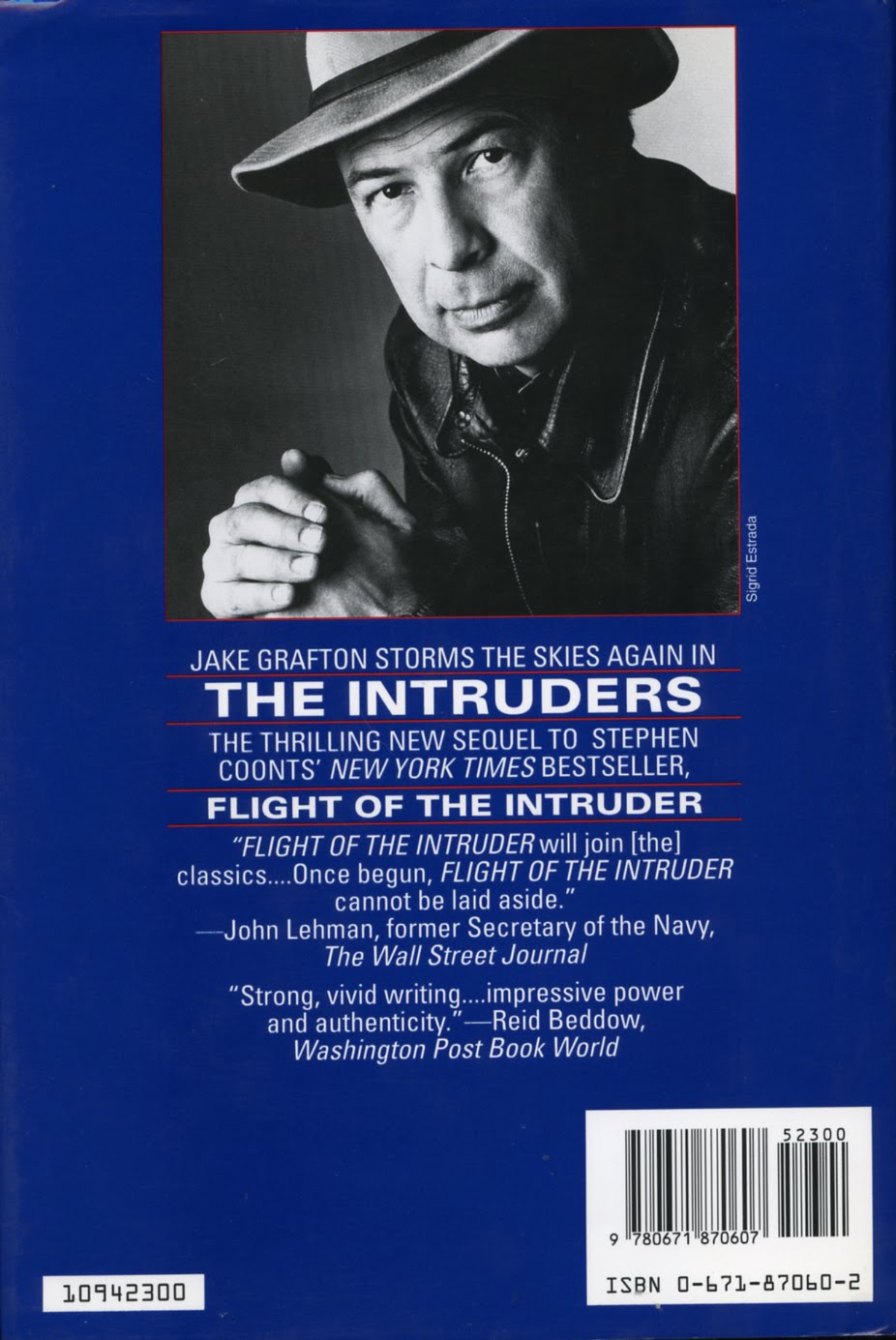
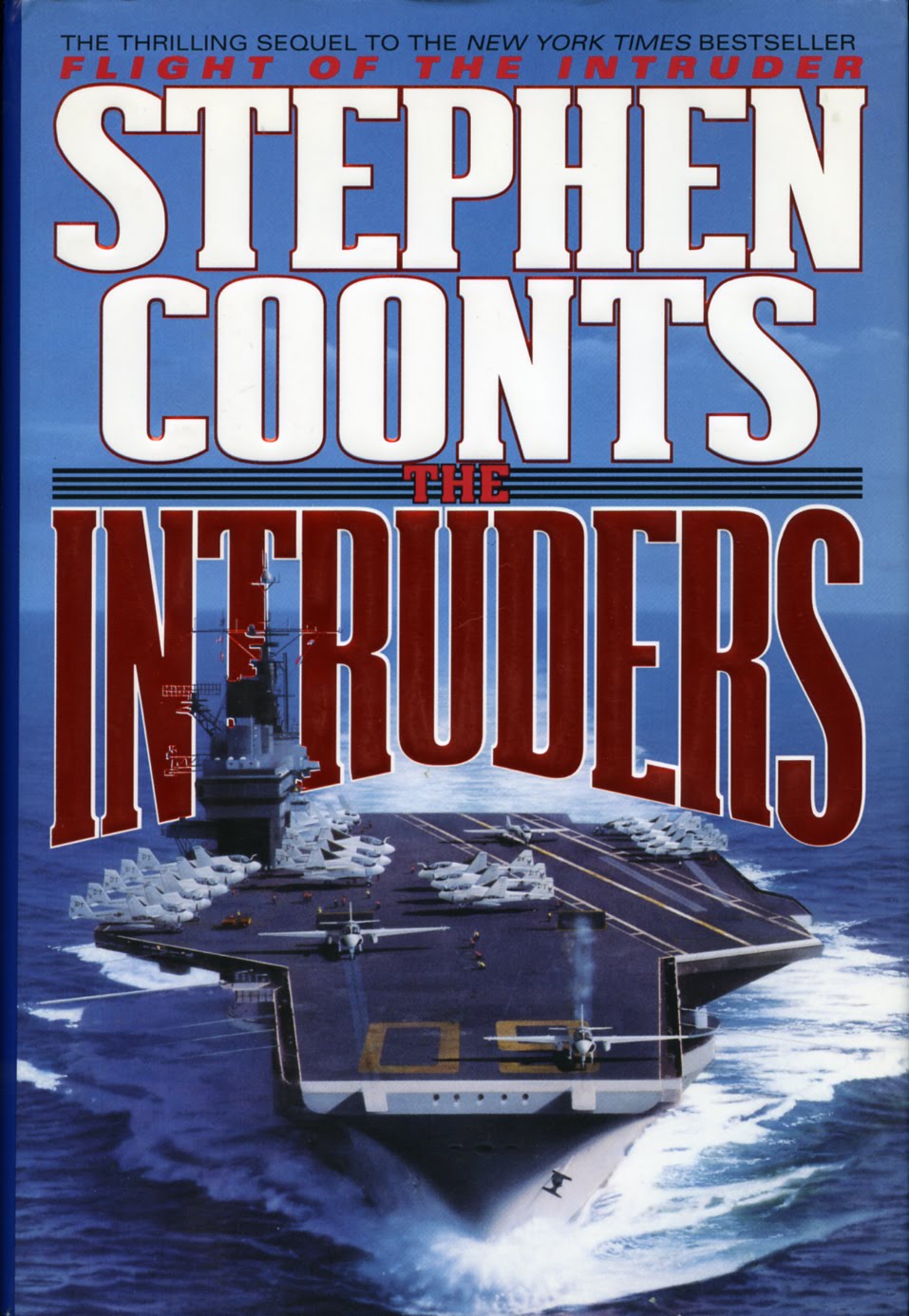
Stephen Coonts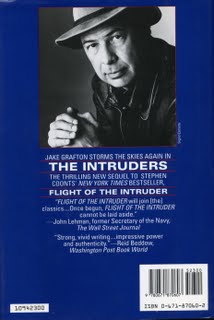 Back in 1984 I had read a new techno thriller called Hunt for Red October by Tom Clancy. There was another novel (far more satisfying for me) also by Tom Clancy, and co-written with Larry bond, published in 1986, Red Storm Rising in which petroleum shortages usher in a scary and most believable WW III. But it was Stephen Coonts' 1986 novel, The Flight of the Intruder, published, like Hunt for Red October (then considered quite odd) by the Naval Institute which I consumed in one night's reading. Its description on what must be the single most difficult job in the world, to land a jet aircraft on the pitching deck of an aircraft carrier at night, left me amazed. Coonts’(himself a former naval pilot) explanation on the workings of the pilot and his tandem seated BN (bomber/navigator) in the Grumman A-6 Intruder left me with extreme airsickness as I understood that the BN spent most of the time looking down on a radar screen and instruments. If I were to do that in a placid flight on a Boeing 737 I would be sick on the spot! Coonts' descriptions of A-6 Intruder night flights over flack and SAM infested North Vietnam was as realistic as the claustrophobia inducing The Boat by Lothar-Gúnther Buchheim, the cold and misery of Alistair MacLean's H.M.S. Ulysses and Nicolas Monsarrat's The Cruel Sea. The fear in the throat of Coonts' hero Grafton was as real and horrific as the fear and gore of Len Deighton's Bomber. 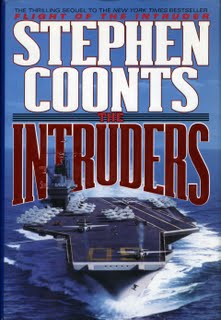 Since I am now a Canadian citizen I have like most Canadians not been a war mongerer or an enthusiast of war. But it is difficult to deny a childhood of playing with swords, cap gun replicas of Western .45s and waging war with toy soldiers on my mother’s lawn. It is difficult to deny the pleasure and awe with which I enjoyed in the 50s my uncle, Luis Miranda’s collection of war-time Life Magazine. I saw the picture of McArthur returning to Leyte there and ads for Buicks that proudly stated that Sherman tanks had Dynaflow automatic transmissions! It is difficult to deny the influence of four years of high school in Austin, Texas and of many trips to the nearby Bergstrom USAF. It was there that I first saw the towering Boeing B-52 and passed my hands on the sharp edged wing of a Lockheed F-104 Starfighter. In the mid 60s while in the Argentine Navy I translated into Spanish the operation and maintenance manuals for the then recently purchased Douglas A-4 Skyhawks. I became intimate with these beautiful (for beautiful they are) airplanes and when the Falklands War happened I was more concerned on the loss of what I considered my airplanes than the death of the Argentine pilots who did well enough and died in equipment that had been obsolete back in my days at the navy. It was difficult to reconcile and understand that my classmates at St. Ed’s in Austin, Texas, as Americans had been part of the Vietnam War that I remember as body count accounts on my weekly readings of Time Magazine. My room buddy John Arnold had been a US Marine who dangled from helicopter cables to save downed flyers in Vietnam. Others from my class died in Vietnam conflicts. My friend grade 9 friend John Straney with whom I had shared my interest in WW II German airplanes and tanks was in the US Air Force in 1967. Of late these classmates have put a face on the body counts and I feel conflicted particularly when I re-read (as I did last week) Coonts’ Flight of the Intruder and its 1994 sequel The Intruders. I cannot so easily dismiss the conservative beliefs of my Texan classmates who own many guns, target practice at least once a week and tell me of their exploits in 'Nam. Who am I to argue after two years of a desk job as a conscript in the Argentine Navy! 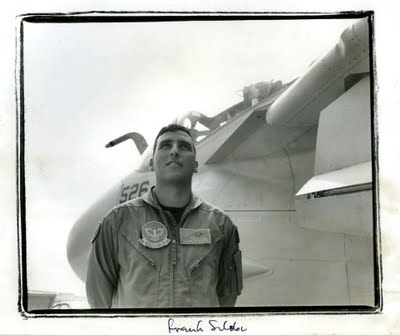 Steam catapults make modern Aircraft Carriers possible. Invented by the British during World War II, catapults freed designers from the necessity of building naval aircraft that could rise from the deck under their own power after a run of only three hundred feet. So wings could shrink and be swept as the physics of high speed aerodynamics required, jet engines that were most efficient at high speeds could be installed, and airframes could be designed that would go supersonic of lift tremendous quantities of fuel and weapons. A luxury for most of the carrier planes of World War II, the catapult now was now and absolute requirement. Steam catapults make modern Aircraft Carriers possible. Invented by the British during World War II, catapults freed designers from the necessity of building naval aircraft that could rise from the deck under their own power after a run of only three hundred feet. So wings could shrink and be swept as the physics of high speed aerodynamics required, jet engines that were most efficient at high speeds could be installed, and airframes could be designed that would go supersonic of lift tremendous quantities of fuel and weapons. A luxury for most of the carrier planes of World War II, the catapult now was now and absolute requirement.
The only part of the catapult that can be seen on the flight deck is the shuttle to which aircraft are attached. This shuttle sticks up from a slot in the deck that runs the length of the catapult. The catapult itself lies under the slot and consists of two tubes eighteen-inches in diameter arranged side by side like the barrels of a double-barreled shotgun. Inside each tube – or barrel - is a piston. There is a gap at the top of each barrel through which a steel lattice mates the two pistons together, and to which the shuttle on deck attaches.
The pistons are hauled aft mechanically into battery by a little cart called a “grab”. Once the pistons are in battery, the aircraft is attached to the shuttle, either by a linkage on the nose gear of the aircraft in the case of the A-6 and A-7, or by a bridle of steel cable in the case of the F-4 and RA-5. Then the slack in the bridle or nose-tow linkage is taken out by pushing the pistons forward hydraulically – this movement is called “taking tension.”
Once the catapult is tensioned and the aircraft is at full power with its wheel brakes off, the firing circuit is enabled when the operator pushes the “final ready” button.
Firing the catapult is then accomplished by opening the launch valves, one behind each tube, simultaneously, which allows superheated steam to enter the barrels behind the pistons.
The amount of acceleration given to each aircraft must be varied depending on the type of aircraft being launched, its weight, the amount of wind over the deck, and the outside air temperature. This is accomplished by one of two methods. Either the steam pressure is kept constant and the speed of opening of the launch valves is varied, or the launch valves are always opened at the same rate and the pressure of the steam in the accumulators is varied. Aboard Columbia, the steam pressure was varied and the launch valves were opened at constant rate.
Although the launch valves open quickly, they don’t open instantaneously. Consequently steam pressure rising on the back of pistons must be resisted until it has built up sufficient pressure to move the pistons forward faster than the aircraft could accelerate on its own. This resistance is provided by a shear bolt installed in the nose gear of the aircraft to be launched, to which a steel hold-back bar is attached. One end of the bar fits into a slot in the deck. The bolt used in the A-6 was designed to break cleanly in half under a load of 48,000 pounds, only then allowing the pistons in the catapult, and the aircraft, to begin forward motion.
The superheated steam expanding behind the pistons drove the length of the 258-foot catapults of the Columbia in about 2.5 seconds. Now up to flying speed, the aircraft left the deck behind and ran out into the air sixty feet above the ocean. When it then had to be rotated to the proper angle of attack to fly – in the A-6, about eight degrees nose-up.
Meanwhile, the pistons, at terminal velocity and quickly running out of barrels, had to be stopped. This was accomplished by means of water brakes, tubes welded onto the end of each of the catapult barrels and filled with water. The pistons each carried a tapered spear in front of them, and as the pistons reached the water brakes the spears penetrated the open ends, forcing water out around the spears. Water is incompressible, water got smaller and smaller, yet as the spears were inserted the escape openings for the water got smaller and smaller. Consequently the deeper the spears penetrated the higher the resistance to further entry. The brakes were so efficient that the pistons were brought to a complet stop after a full-power shot in only nine feet of travel.
The sexual symbolism of the tapered spears and the water-filled brakes always impressed aviators – they were young, lonely and horny – but the sound a cat made slamming into the brakes was visceral. The stupendous thud rattled compartments within a hundred feet of the brakes and could be felt throughout the ship.
Tonight as he sat in the cockpit of an A-6 tanker waiting for the cat crew to retract the shuttle, Jake Grafton ran through all the things that could go wrong with the cat.
The Intruders, Stephen Coonts, 1994And in a later chapter that sheer bolt does break off prematurely which leads to some of the most exciting writing account on how Grafton is able to stop his plane before it rolls: Sliding, turning left and still sliding forward…he felt the left wheel slam in the deck-edge combing, then the nose, now the tail spun toward the bow, the whole plane sliding…
And he stopped.
Out the right he could see nothing, just blackness. The right wheel must be almost at the very edge of the flight deck.
He took a deep breath and exhaled explosively.
His left hand was holding the alternate ejection handle between his legs. He couldn’t remember reaching for it, but obviously he had. He gingerly released his grip.
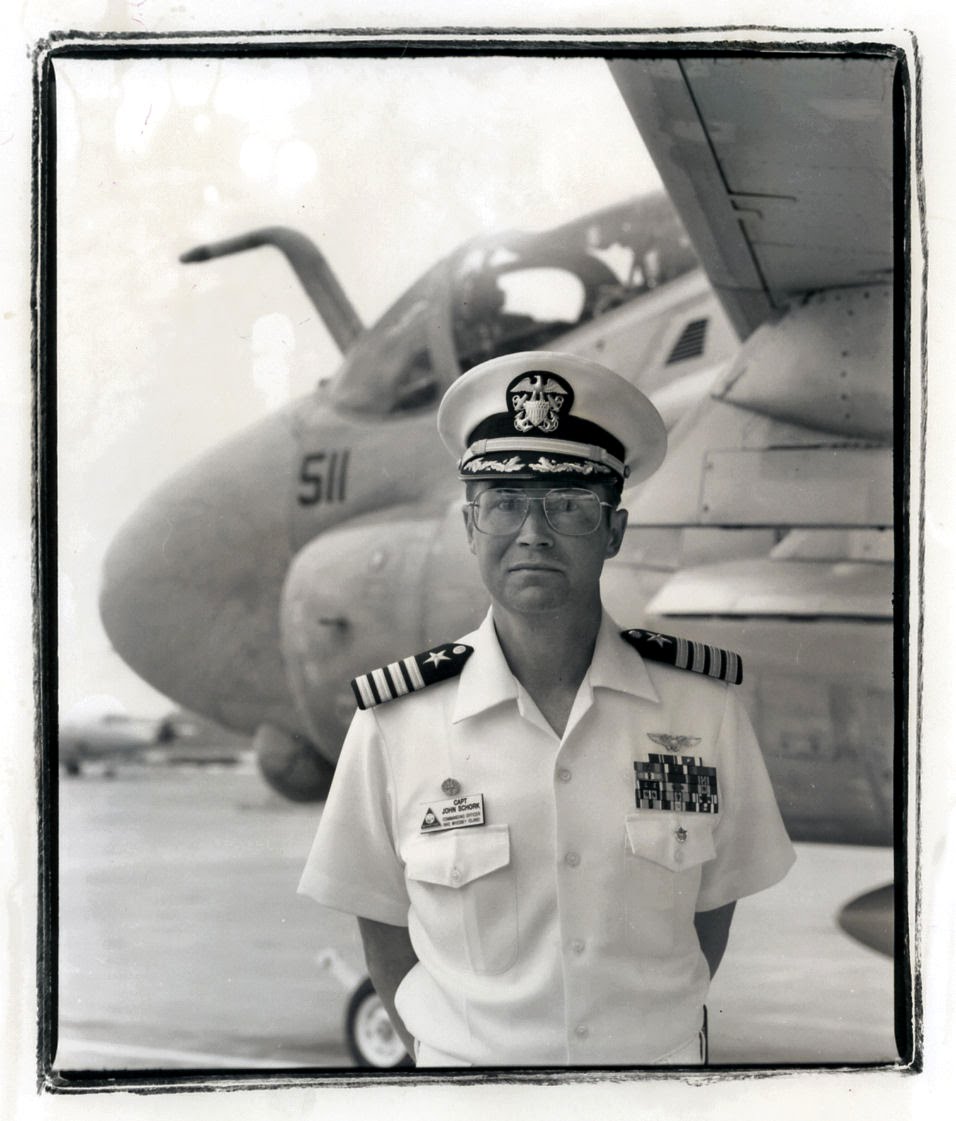
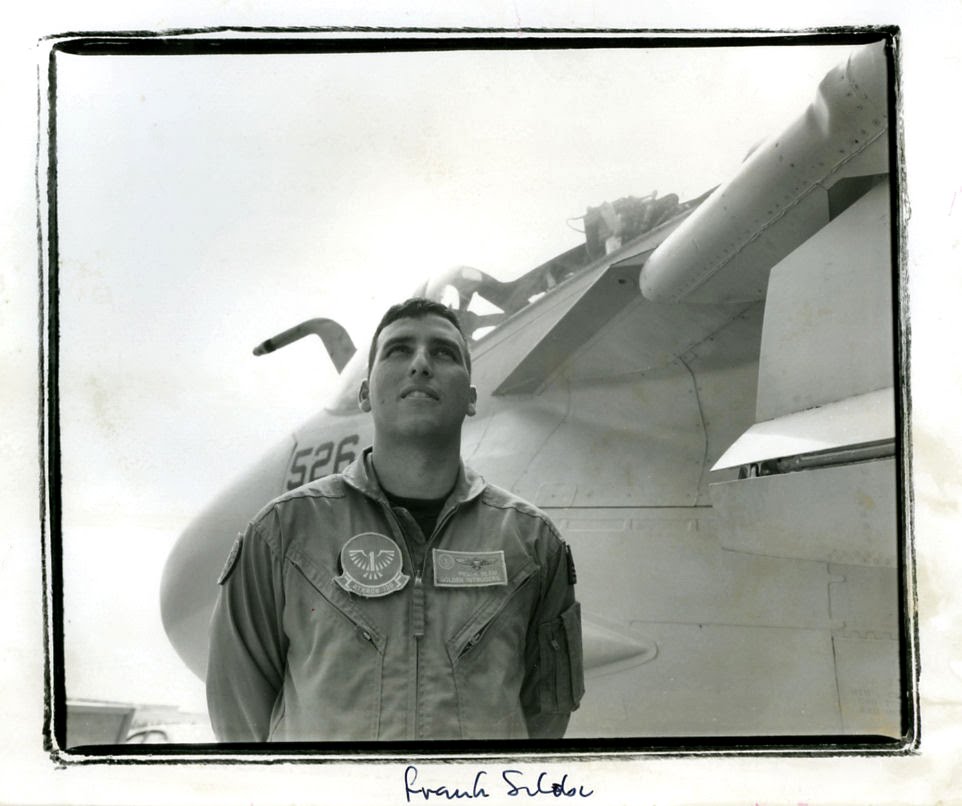
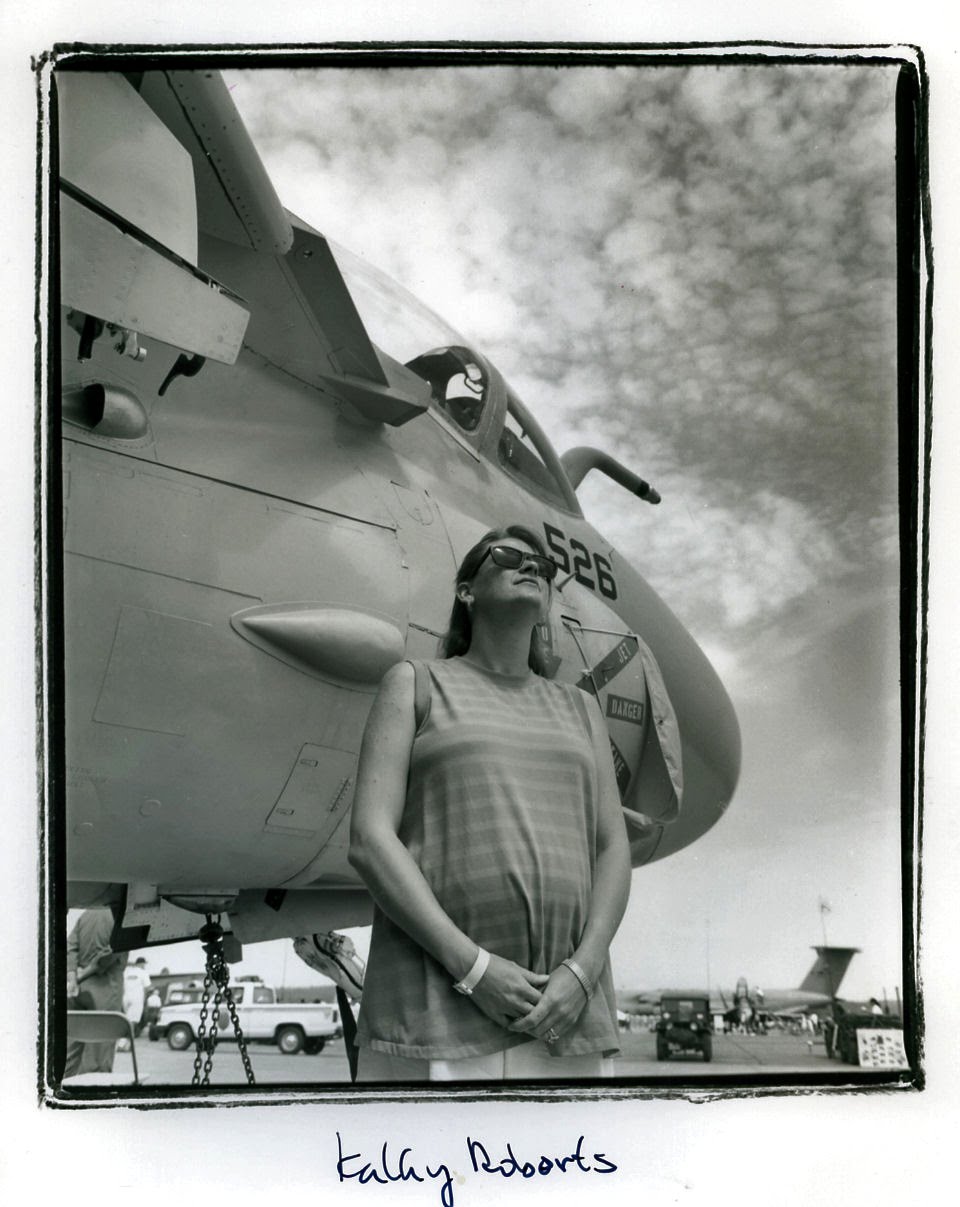
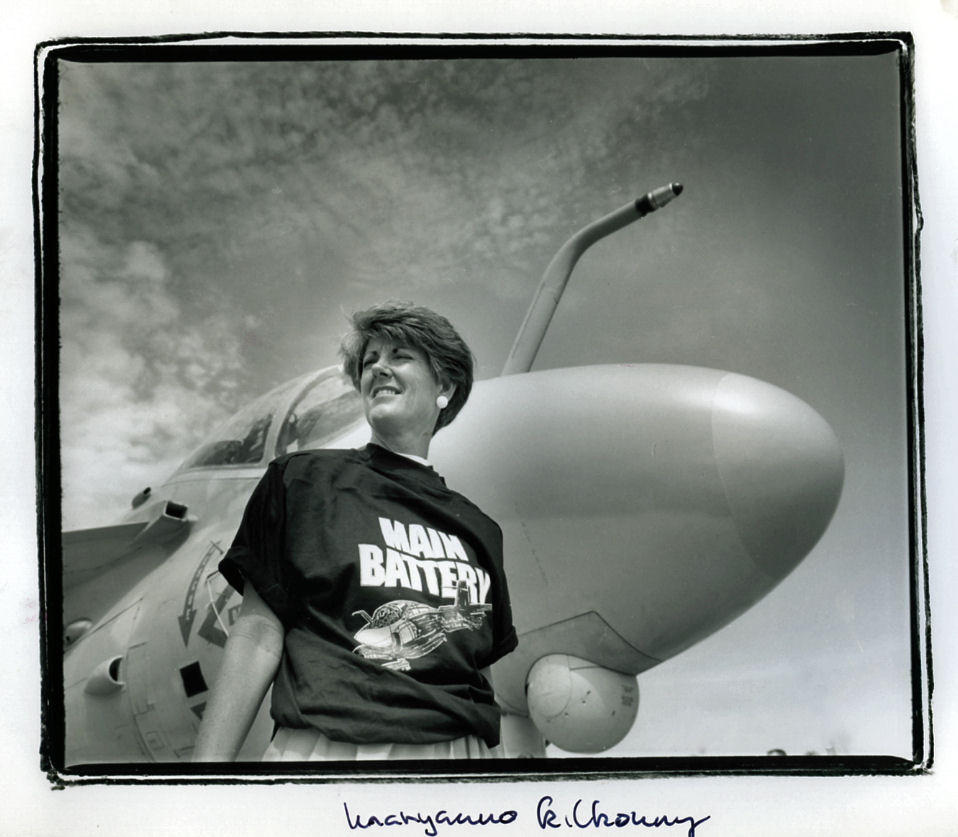
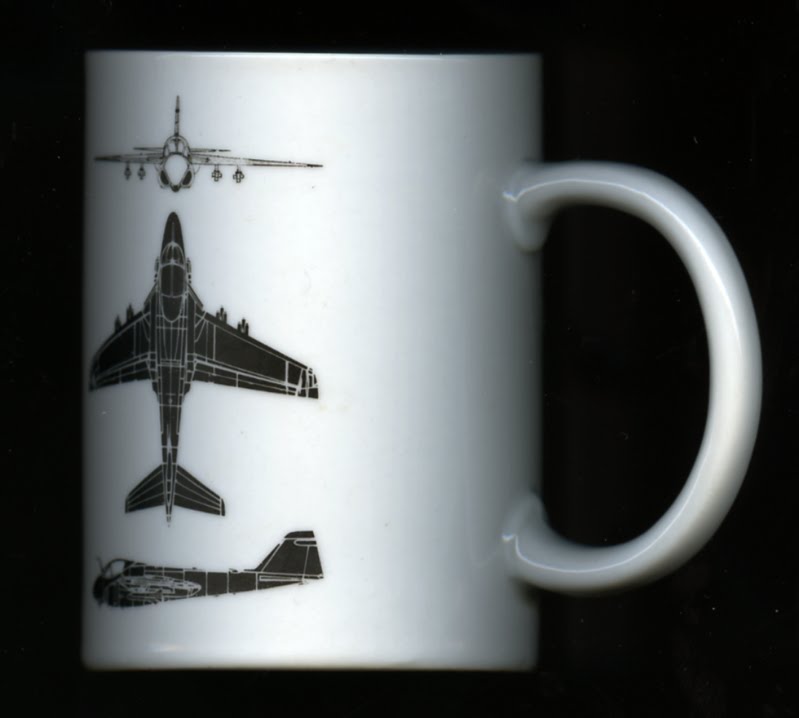
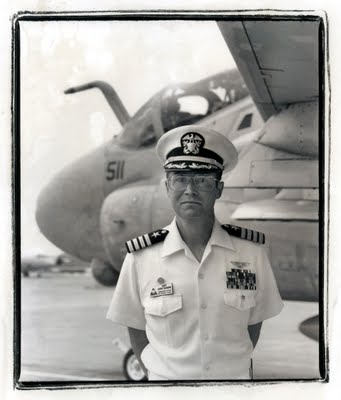
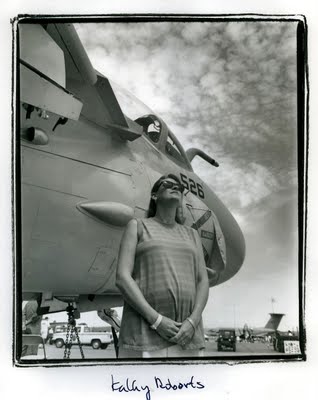
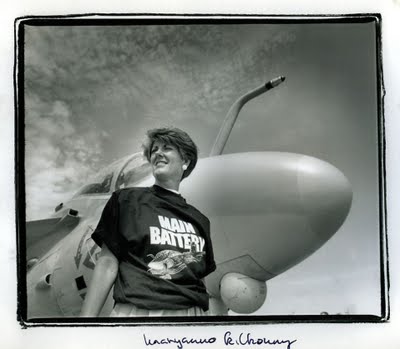
The Intruders, Stephen Coonts, 1994 My fascination with The Flight of the Intruder led me to go to several air shows at the Whidbey Island Naval Air Station near Oak Harbor in Washington State. I went with my friend Sean Rossiter who like me is an airplane enthusiast. At Whidbey Island I thrilled at watching A-6 Intruders fly. And it was in July 1994, my last visit that I found out that the A-6s where being phased out and replaced by F/A-18 Hornet. I talked to pilots who told me that the thrill (and fear!) of piloting an A-6, very low (skimming the trees) at night and in bad weather could never ever be replicated by the Hornet. In fact to this day the Hornet can not match the Intruder’s range and payload. During its existence as an attack plane (A-6s were never used as fighters but to bomb, strafe military installations and ships) the Intruder could carry a bomb payload that was second only to that of the Boeing B-52. My excitement at seeing the Intruders and taking photographs of the then base commander (who had flown Intruders) Captain, USN John Schork led me to propose to Rossiter that we collaborate on a story and to try to sell it to magazine. We never found anybody interested even though Coonts in his letter to me suggested a few venues. The story died even though Rossiter wrote it. In my files today I found two versions of Rossiter's 6 page story. I called him up for permission to run it. Permission has been granted (story will follow sometime today). Since 15 August 94 when Rossiter wrote his second draft he lost all records of it. The publishing of the story in the blog will be a pleasant and now anticipated surprise for him. 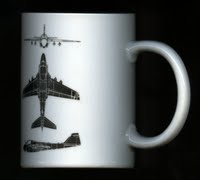 When I re read The Flight of the Intruder (all about Vietnam) and then its sequel The Intruders (no war) I was able to read the technical stuff with far more enjoyment. My ignorance of naval aviation is perhaps the only reason why in my Buenos Aires war games I was never a naval pilot! The splotches of the pictures here are result of bad fixing of my prints. They are Ilford resin coated paper not known for being all that archival. My b+w negatives of these Intruder people are pristine. I like the look of the deterioration. Stephen CoontsAnd would you believe it, Captain John Schork is now an author of aviation novels! Captain John ShorkNot related but still within the subject Sukhoi
Tuesday, February 16, 2010
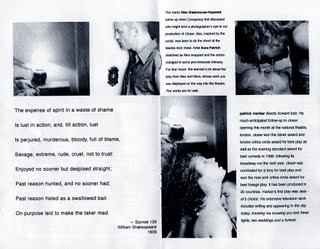
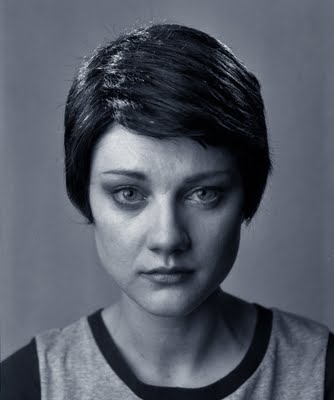 The expense of spirit in a waste of shame
is lust in action; and, till action, lust
is perjured, murderous, bloody, full of blame,
Savage, extreme, rude, cruel, not to trust:
Enjoyed no sooner but despised straight;
Past reason hunted, and no sooner had
Past reason hated as a swallowed bait
On purpose laid to make the taker mad.
Sonnet 129, William Shakespeare 1609
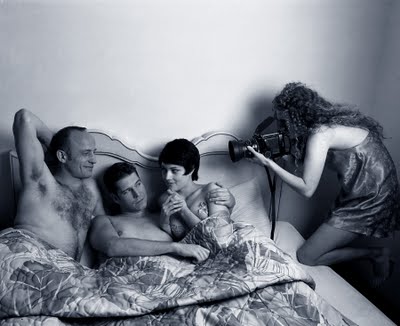
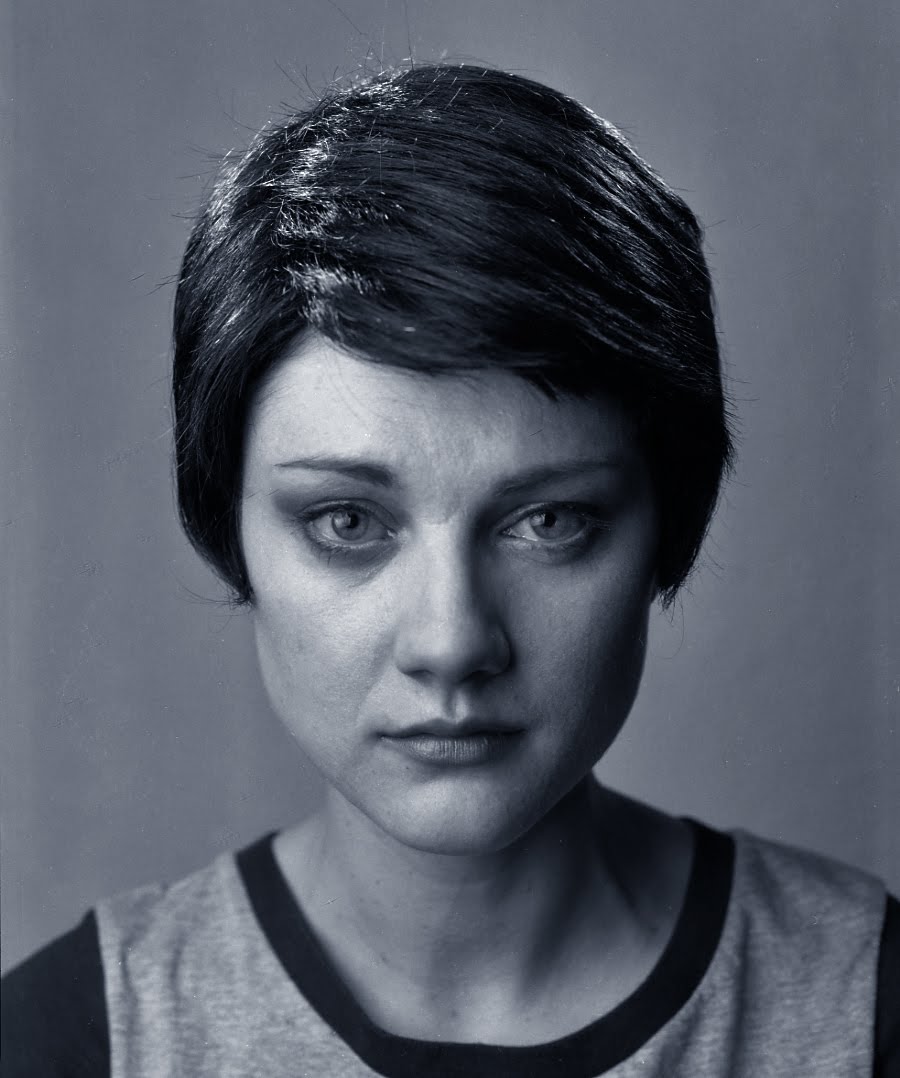
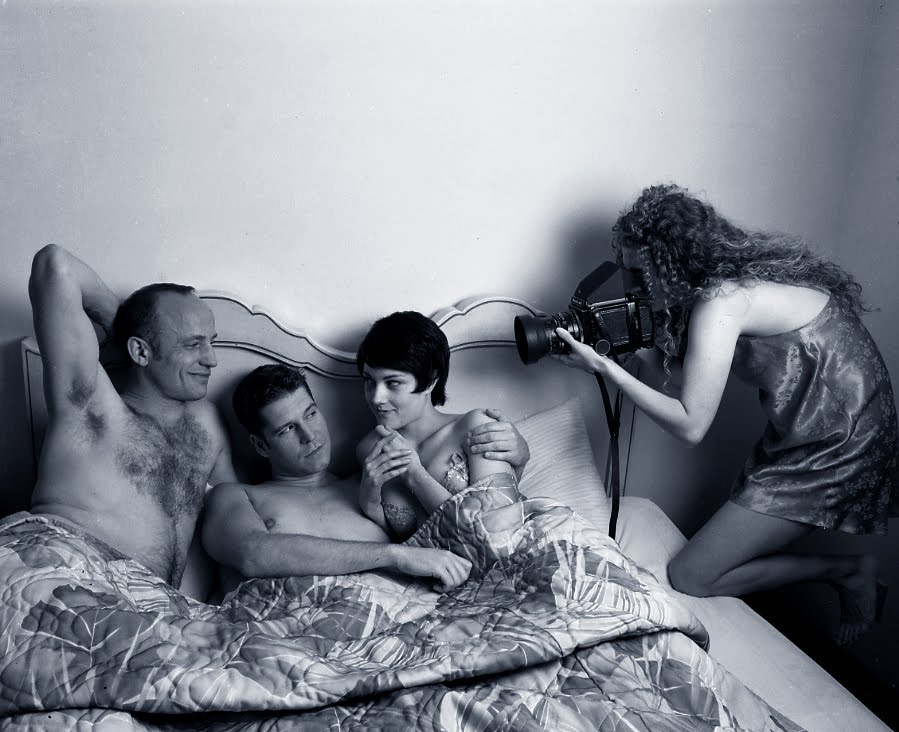
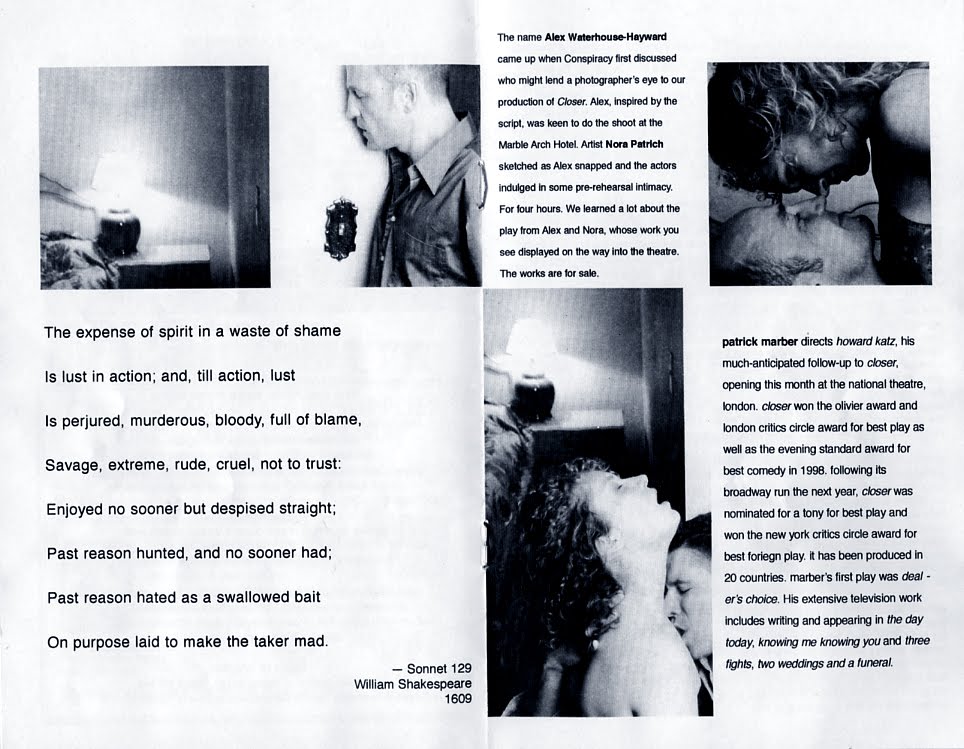
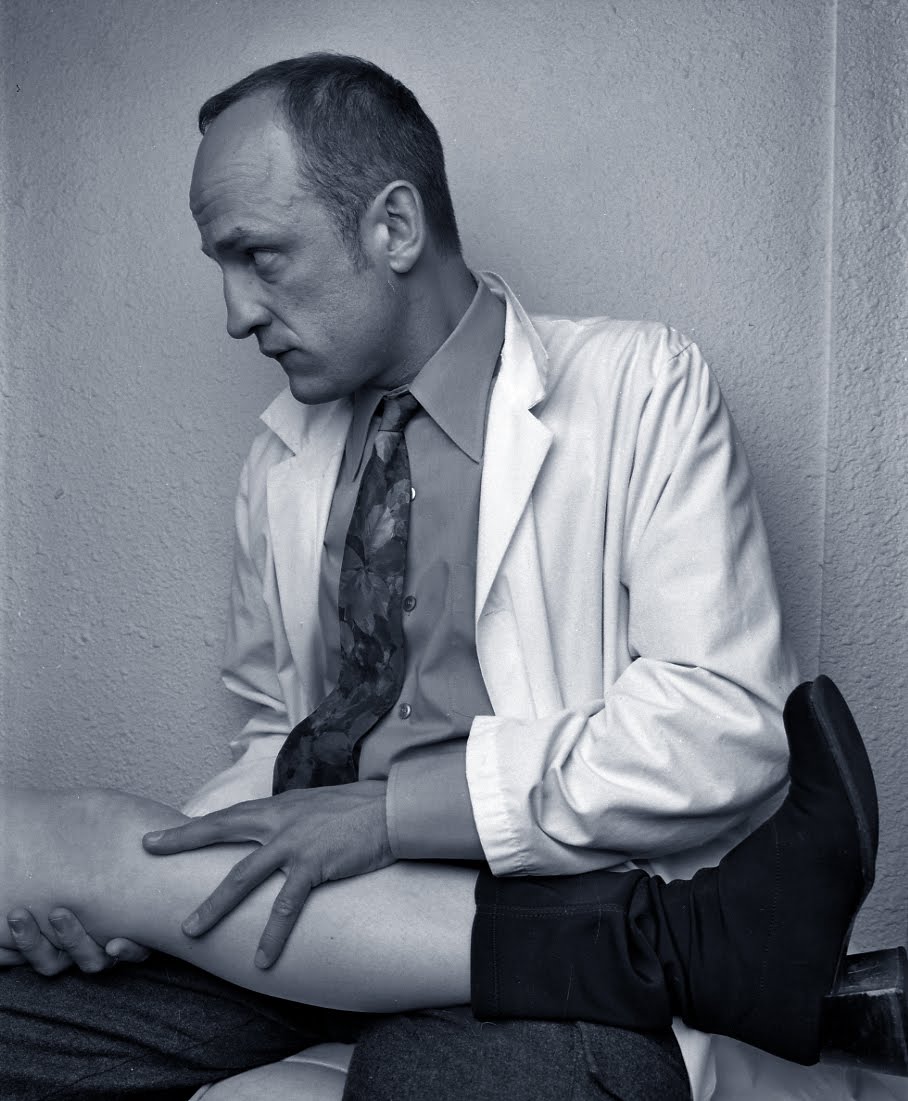
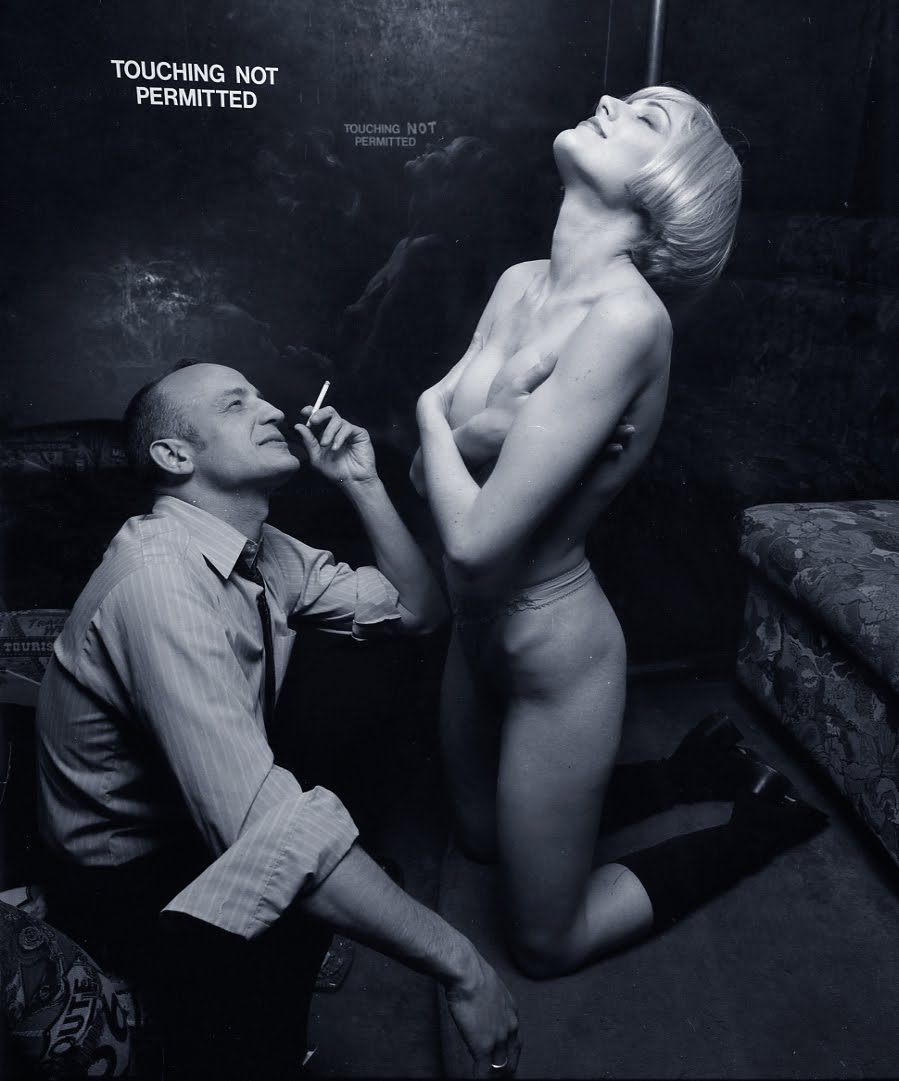
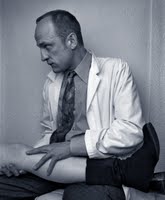
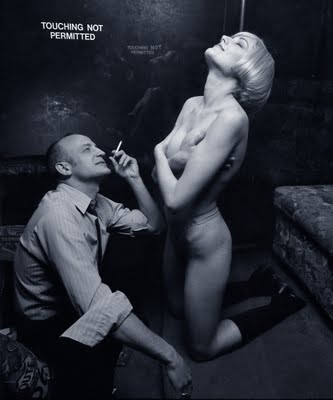
Sometime in spring of 2001 I was approached by Richard Wolfe and Tim Carlson of Theatre Conspiracy with an offer I could not refuse. They were going to mount a performance of Patrick Marber’s play Closer (June 7-16) and they wanted me to take pictures even before the rehearsals began. Wolfe was the director and Carlson the assistant director. The idea is that our pictures (in collaboration with Argentine painter Nora Patrich) would serve as special promotional photographs, as photographs to be used in the program and the photos and collaborations with Patrich (part sketches and part photographs) would hang the night of the opening in large frames.

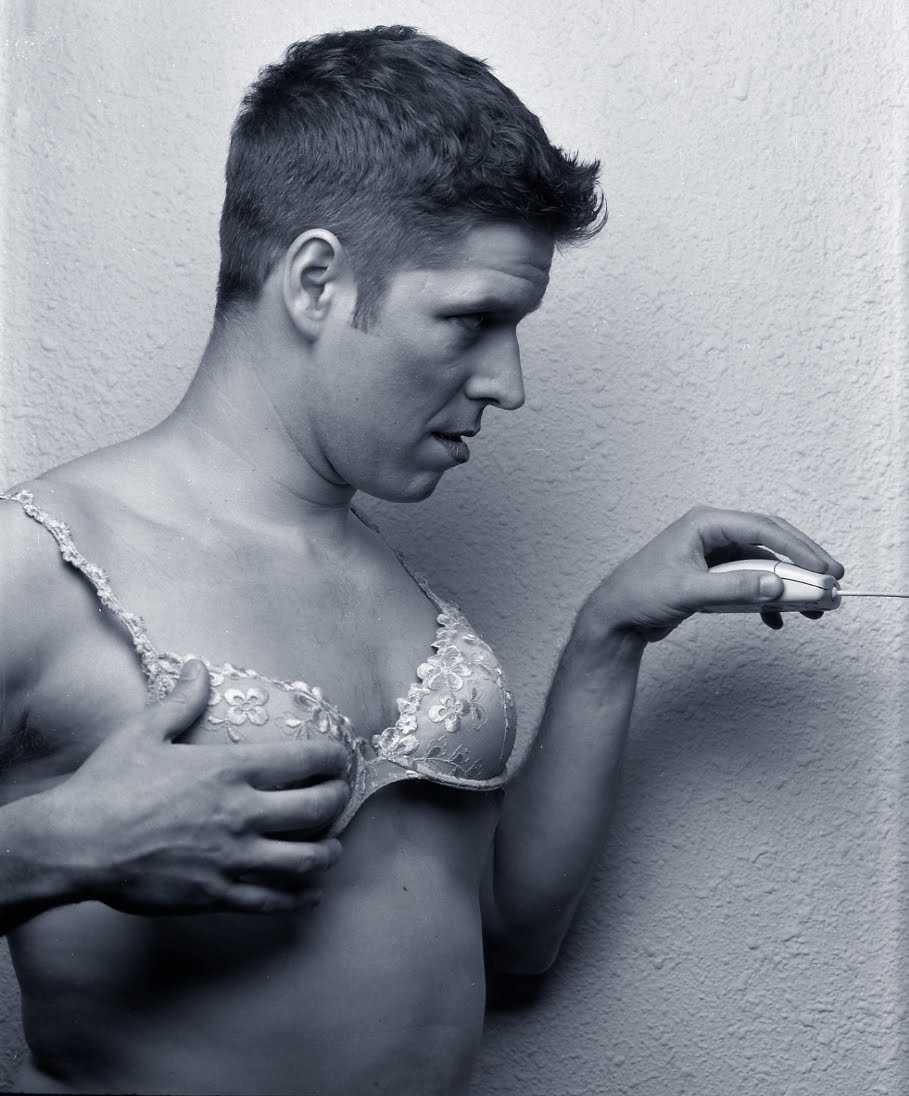
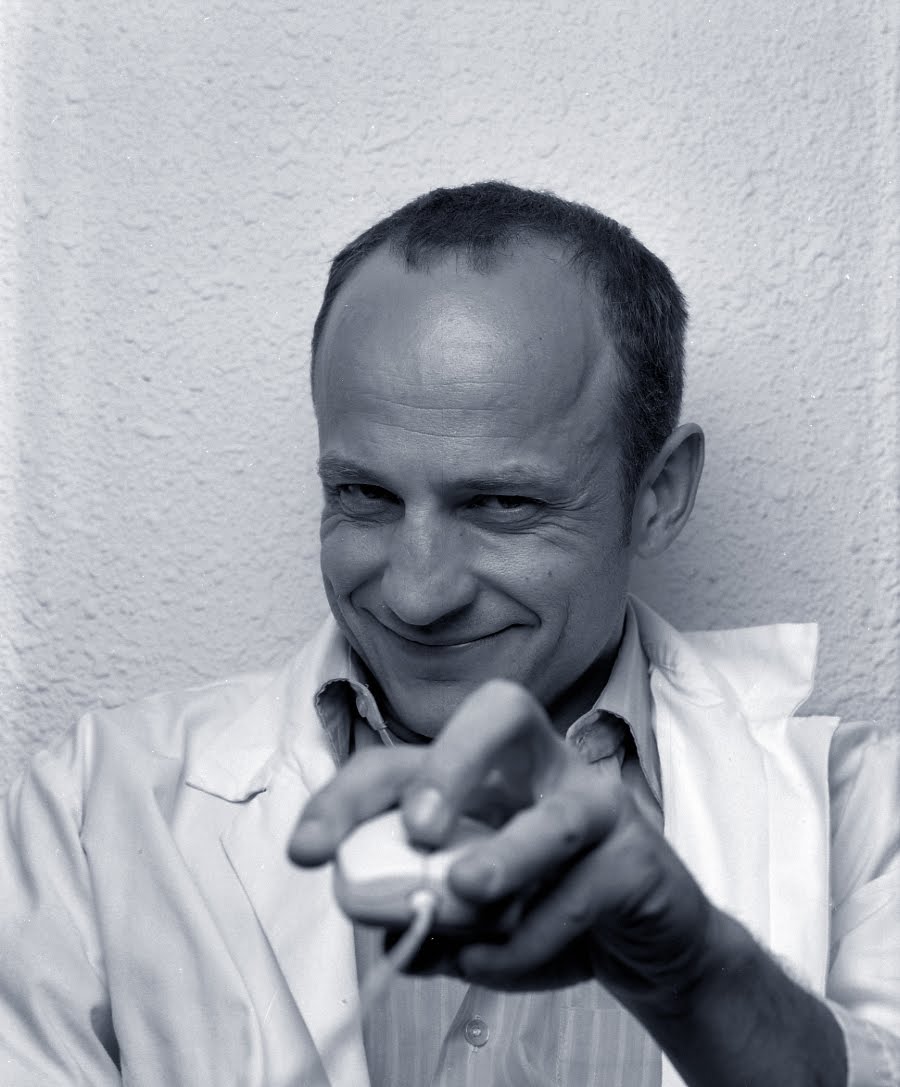
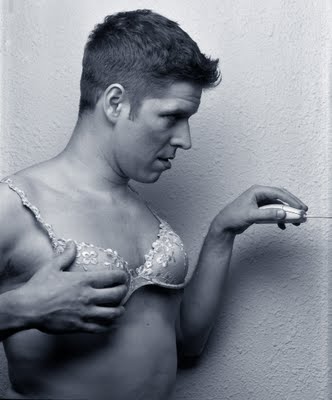
The actors Kurt Max Runte (as Larry, seen here in a doctor’s smock) Steve Griffith, Michelle Harrison ( Alice seen here as the stripper) and Sarah Louise Turner ( Anna as the photographer) had not really met. Patrich and I put them into a room of the Marble Arch (we had read the script) and set up the shots. We were in the room for four hours. What was really amazing for me is that I had forgotten that actors can act, particularly on demand with short notice! I would give them instructions and they would do as told. I would only need to shoot one or two frames. Runte and Harrison posed in one of the real stripper booths of the Marble Arch. It felt authentic. The amount of emotion we were able to extract from these four was an experience I will never forget.
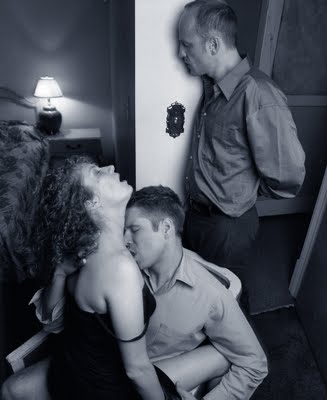
I have seen some excellent theatrical pictures in Vancouver through the years but just this time I will beat on my own drum to opine that these pictures are really special.
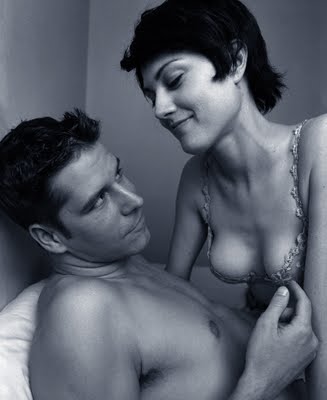
If you read the plot synopsis here you will understand the gist of the pictures and the reason for the camera, the doctor's smock, the mouse and Steve Griffith (Dan) in drag.
Anna. "She has one address in her address book; ours ... under 'H' for home."
Dan. I've cut that line.
Anna. Why ?
Dan. Too sentimental.
Dan. What do you want ?
Alice. To be loved.
Dan. That simple ?
Alice. It's a big want.
Larry. It's about you, isn't it ?
Alice. Some of me.
Larry. Oh ? What did he leave out ?
Alice. The truth.
Pluto Platters & Wham-O Blowguns
Monday, February 15, 2010
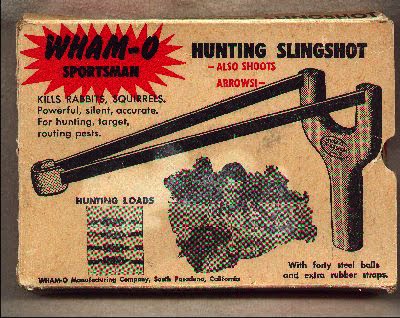
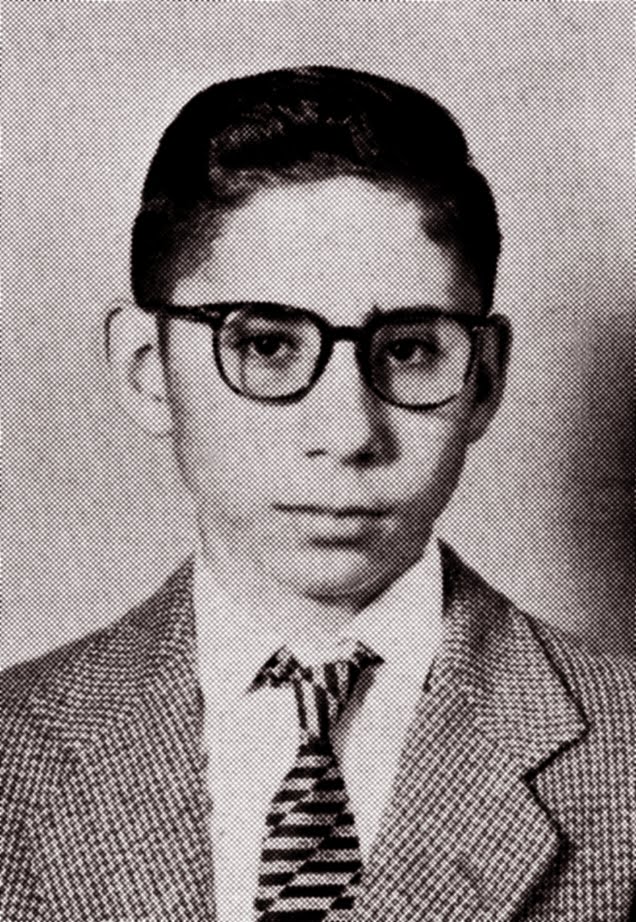
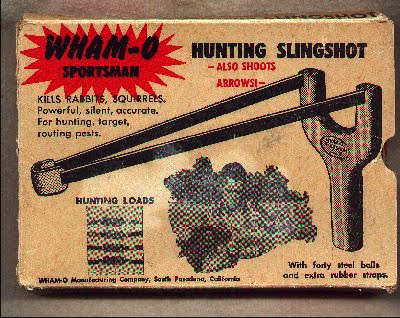 On February 13 I read in my hard copy NY Times: Walter Fredrick Morrison, who at 17 sent the lid of a popcorn tin skimming through the air of a California backyard and as an adult remade the lid in plastic, in the process inventing the simple, elegant flying disc known today as the Frisbee, died Tuesday at his home in Monroe, Utah. He was 90.I was not aware that Morrison’s invention before it was bought by the Wham-0 company in 1958 had been called the Flyin’ Cake Pan, the Whirlo-Way the Flyin’-Saucer and finally the Pluto Platter. I read the obituary with nostalgic interest but I must clarify that I never did master the art of throwing a Frisbee. It may have been sometime around 1959 when the Frisbee arrived to St. Ed’s High School in Austin, Texas. The master of the sailing art was my friend (and now a successful dentist in Houston) Steve Burdick who tried his best to teach me. My expertise with wrist work involved the ping pong paddle. I was one of the best in school in that game. The Frisbee was never my thing and I remember young men throwing them in Kitsilano Beach here in Vancouver in the mid 70s. They often played the game with their dogs. I found the whole exercise kind of silly! My son-in-law Bruce Stewart plays something called Frisbee Golf. While the Frisbee and I never did get along I had an early relationship with the Wham-O company in 1957 when I was a nerdish freshman at St.Ed’s. 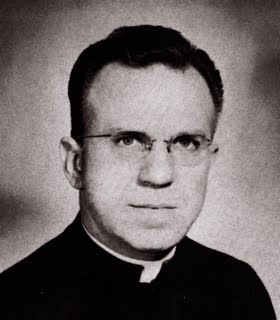 Because I was an Argentine born boy who had lived in Mexico so that my accent was a blend of Argentine and Mexican I was considered an outsider by la Raza (those that were either Mexican of Mexican heritage) while the white Texan/Americans considered me a foreigner (even though I, too was white and spoke English). I was in between and part of neither camps. I was left to my own resources. 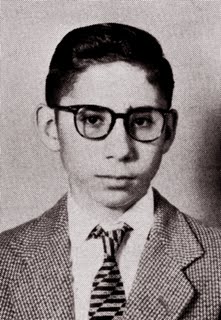 So I took advantage of the efficient American postal system and became a member of a “club” in which I purchased b+w glossies of airplanes including military fighters, vintage WWI and II plus the more recent jet fighters and bombers. The club also had a new section and I began to collect photographs of what they called guided missiles. I remember the BOMARC and the Nike. I also constructed gadgets. My source of materials for these gadgets was an army surplus store on Congress Avenue that was very close to the Congress Avenue Bridge (before the bats settled in). It was at that store that I bought a special compass that I could adapt into a flying-saucer-spotter. The compass could be opened so I was able to put two electrodes on either side of North. The electrodes I connected to a buzzer that was battery-powered. At night I would position the device under my bed with the compass pointing north. The idea behind the gadget is that many in those flying saucer sighting days had read (as had I) Major Donald Keyhoe’s The Flying Saucers Are Real and Flying Saucers From Outer Space. We were thus aware that the proximity of a flying saucer would affect the magnetic field. This meant that a nearby compass needle would fluctuate. If I had built my gadget correctly the buzzer would sound! What I was not aware until Brother Vincent De Paul, CSC punished me for waking up part of the dormitory one night was that large tractor trailers also modified the magnetic field. Brother Vincent commanded me to disconnect my compass. I shifted my interests to potentially more destructive and dangerous endeavours. I purchased a Wham-O sling shot. I remember when it arrived in a little brown package. You loaded the leather pouch with steel balls or copper BBs. I was soon practicing by the creek with glass beer bottles.  When I saw an ad for the Wham-0 blowgun I rapidly lost interest in the sling shot. It arrived in a longish box. It was partly collapsible in that you connected the rear part with the hand grips to a front part. It came with steel darts that were five inches long. The weapon was silent and I soon came to realize that it was dangerous and could be deadly. Do you think the Brothers of the Holy Cross would have taken it away from me? Absolutely not, as far as Brother Vincent was concerned my “toys” made no noise at night! For a while I practiced to see how much my darts would pierce plywood. But the weapon was useless with beer bottles. I visited the army surplus store and bought a co2 cartridge powered air pistol. I also bought a Spanish American War vintage leather holster (used for carrying a .45 caliber automatic). While many of my classmates became members of the National Rifle Association and joined the Rifle Club run by Brother Stanley Repucci I was never tempted. I perhaps did not know then but I might have already been a liberal who believed in gun control and a Canadian type of socialized health care system. I did not have the credentials to ever be a Texan. But I did practice by the creek to see if I could unholster the gun as quickly as Matt Dillon. Brother Vincent did not take away my air pistol. It was in the summer holidays before I returned to St. Ed’s for Grade 10 that I ran into my first and last incident with my toys. In Nueva Rosita, Coahuila where my mother taught school to the children of the engineers of the American Smelting and Refining Company, we lived close by to a our American bowling alley. I remember spotting the older man who ran it, Juan standing by the door. Without thinking I put a dart into my blowgun and blew. The dart penetrated the door, inches from his face. My mother took away the blow gun. I was too old for an old-fashioned paliza (whipping). Addendum: My son-in-law, Bruce Stewart has informed me that he does not play Frisbee golf. "It is called disc golf because if you were to try to catch one of these it would break your fingers."
Le Roi Est Mort, Vive Le Roi!
Sunday, February 14, 2010
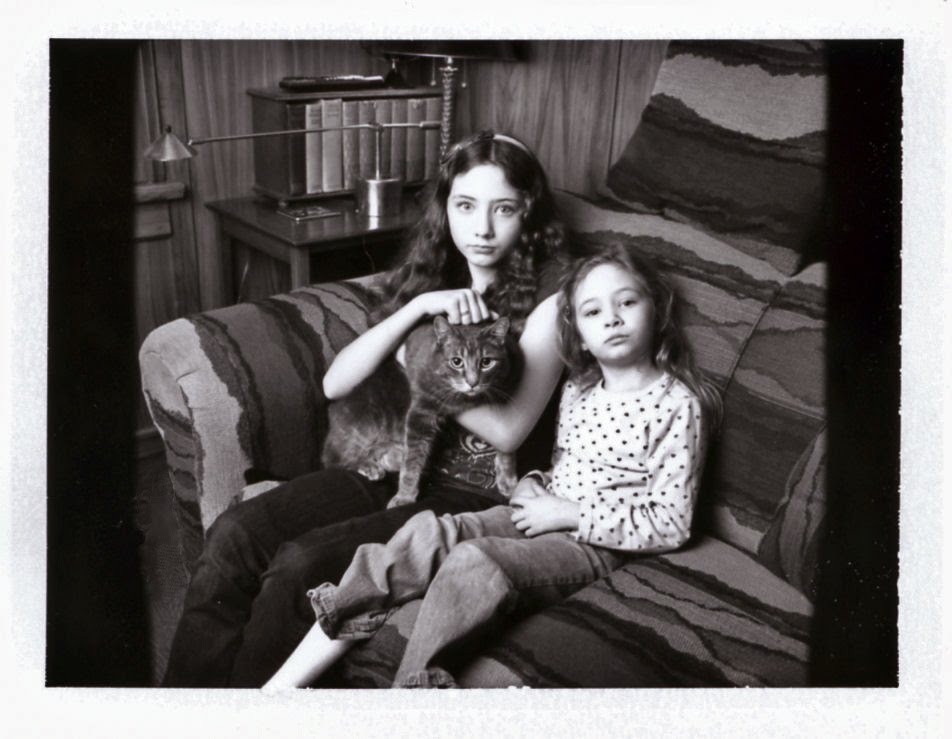
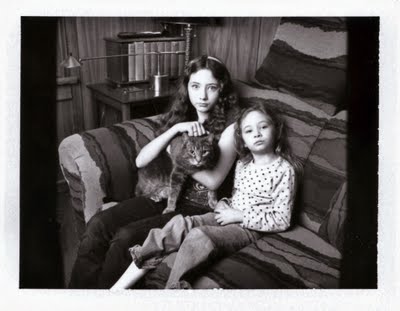 Le Roi est mort, vive le Roi! Friday was indeed a sad day. I took Toby to the SPCA. I almost felt that Toby was apologetic when he soiled his plastic cage in the car. When Dr. Peter Lekkas saw Toby and noticed how far he had deteriorated after a previous visit a couple of weeks ago he looked at me and we both agreed on the course of action. I told Dr. Lekkas that while he dealt with Toby I was going to cross to the adoption side to see if some cat would appeal to me. That being the case I was going to adopt the cat, right on the spot, take him home and present Rosemary with a fait accompli. I did find a cat but I was not able to take him home. The cat I saw was in a sterile quarantine section of the SPCA because many of their cats had suffered from respiratory diseases. They had all been kept apart just in case. In order to see the cats I had to slip into plastic booties and then stand for 30 seconds in a strong disinfectant. There was one cat I immediately noticed. He was a very large gray tabby with almost no markings, with strikingly large eyes of an unearthly yellow green. He was pleasant, low key and affectionate. His name was Kassy which was short for Kassynova [sic]. When I told the woman in charge that I was interested in Kassy she asked me, “Which cat is she?” The folks at the SPCA told me that Kassy, 6, was a one cat household cat and that he was most definitely a house cat. That he was a house cat was evident as the 18 pound cat was certainly overweight. I was further told that he had never been around children. It seemed it was all stacked against me. I told them I wanted to take the cat anyway but I was denied. There is a new regulation that stipulates that if a person wants to adopt a cat in a two-person household the other person has to be there. Dr. Peter Lekkas tried to “fix” the situation by vouching that we were cat people and that I was not married and had no wife! I went home minus the cat. Rosemary reluctantly told me that we would go the next day with the girls but she didn’t think she was ready for another cat just yet. I was thinking that as our financial fortunes diminish going from one cat (an eventually to none) might be our ticket if we plan to travel and or live in a small apartment. Both Rebecca and her mother Hilary said I should get another cat that would be Rosemary’s, as Toby had been. Rebecca was precise, “Abi thinks that Plata (my female cat) is a bitch. She wants a cat of her own.” So we went to the SPCA and all four of us crowded into the room wearing our plastic booties. Kassy sat on our lap, one at a time. He never hissed or in any way showed any inclination to be aggressive with the girls. I said nothing but Rebecca kept harping to her grandmother that this was indeed the cat that was going to be hers. We left the SPCA with our cat. Both Lauren and I decided that Kassy would go back to his original name but spelled correctly. He would be Casanova and we would call him Casa for short. He is big as a house so the name fits. During the whole two days Rosemary was so confused and worried about a possible adoption that she never really stopped to consider that I had returned Friday afternoon with Toby in a box. I opened the box in the garden to find a white towel that was wrapped almost in a ball. I could see Toby’s lovely white front paws sticking out. I had no heart to look any further. I dug the hole and put Toby in it. It began to drizzle as I covered the hole with leaves and dirt. As Rosemary said when I went up the stairs, “Toby is home.” Plata did not know what to do when we arrived on Saturday with Casa. Casa was a bit shy and would hide under the bed (as cats so expertly manage to be in the exact centre so you cannot reach them). But by today Sunday Casa knows where the litter box is. He is friendly with everybody and allows himself to be picked up (if you are able to!) without any fuss. Rosemary had Casa on her chest while lying in bed. She is not too sure about Casa. She likes the traditional tabby cats with lots of markings on the body and those lovely white paws that Toby had. Rebecca pointed out that Casa is indeed a tabby as he has an M above the eyes. I have a feeling that Rosemary and Casa, Casa and Plata, will be friends real soon. We will not forget Toby. Today Rebecca called to say she, Lauren and their Nana wanted to pay us a visit so that Nana could meet Casa. We had hot chocolate and tea. I had the opportunity to take this Fuji instant print so that you can see Casa, at home.
The Cat In The Box
Saturday, February 13, 2010
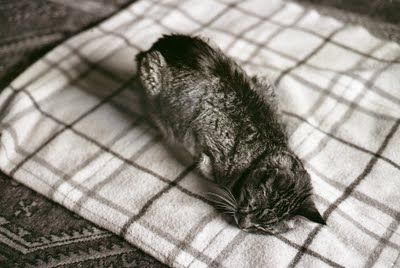 This blog will have Saturday February 13th as the date but I am writing it today Friday a little past noon. I feel I cannot do anything except anticipate with some dread my drive with Toby at 2:30. Our 19 year-old cat Toby is going on a one way trip to the SPCA today. I will bring him back in a shoe box and bury him in the garden. To the end Toby has done his best to be a clean cat. This morning he jumped from our bed and he did his business on a pile of newspapers by the bed. A couple of days before he had rolled down the stairs to reach the kitty litter box in the kitchen. That must have hurt! He has done his best. Last night he wanted to jump off the bed but Rosemary was on the phone and prevented him from doing so. The jump from the bed would have been pain. We had to wash our sheets and Toby himself was a mess. I gave him a warm shampoo bath to clean him up. He did not struggle. I do believe that Rosemary knows her cat has to go. It will be unpleasant tonight and I will not be able to comfort her. I have always maintained that the quickest cure to a dead cat is a brand new one. I am not sure that we are ready to have another cat. The new cat would have to adapt to our female Plata who is fairly high strung. As our life winds down, having pets at home always puts a pressure on having to find someone to take care of them when we travel, even when it is a two-day stay at Ale’s in Lillooet. But a new cat would help bury some of Rosemary’s grief tonight. I will have a look at the cats at the SPCA. Who knows? Will Toby be the only cat (in a box) as I return home tonight?
Ellen Bry - Olympic Pheromones
Friday, February 12, 2010
It is fascinating how the intention of a meaning can vary with a language. Take for example the Spanish term aguafiestas. It literally means a person who waters down a party. My guess it has to do with the idea of diluting the booze or unspiking the punch bowl In English the term party pooper is self-evident and I wonder if there is a continuity of connection with the American term, “as funny (or as popular) as a turd in a punch bowl”.
I don’t want to be an aguafiestas with these 2010 Olympics. Perhaps I will wake up in a few days to experience that spirit our Vancouver Sun writes about. I certainly don’t want to emulate the spirit of that man that visits Rick Cluff’s Early Edition on CBC Radio 1 on Mondays. The man in question has trivialized and cheapened Bill Vander Zalm’s famous use of the word fantastic. That indefatigably tedious man should be pushed down the Olympic ski jump at Whistler. Fantastic! I have a feeling that Cluff would help me push. But I will stop here before I am accused of ranting.
I don’t want to be an Olympic party pooper. Even I, hope that Canada, my adopted country, reaches the gold medal final for men’s hockey. Of the other sports I will pass, and I will diverge to a holding pattern around pleasant matters. One that I re-discovered by accident last night was a file called Bry, Ellen.
Knowingly I have never seen this American actress (born in 1951) in any film. I never saw a single episode of the cult TV series St Elsewhere and I have avoided any TV programs with pointy eared characters that did not feature Leonard Nimoy as Mr. Spock.
I met Bree only once in 1987 in Whistler. I had gone there with Les Wiseman to report for Vancouver Magazine the goings on of a celebrity ski-a-thon. I don’t think that Wiseman ever did write two lines on any of the 2 or 3 ski-a-thons we attended. He found ways of convincing our editor, Malcolm Parry that this was a worthy pursuit and that we should go. The real reason was that the Whistler organizers promised the presence of Brooke Shields. Wiseman had a thing for her. Shields never did show up so we nursed single malt Scotch and sodas and photographed and interviewed as many other “celebrities” we could find. At the time Wiseman had a column for TV Guide. I guess some of what he wrote found a home there. In my case the one big break was a TV Guide cover of that other St. Elsewhere star, Bruce Greenwood.
When Wiseman and I met Bree, neither of us knew who she was. Wiseman consulted with a PR man who clued him in. The cluing did not come soon enough as it seems that I went up to Bry and told her, “We are a couple of ignorant Canadians. Who are you?”
I have very little memory of what transpired after that. Wiseman says Bry invited us to a party up in the mountain yet the picture here has her in a very nice low cut dress.
What I do remember is that when she faced my camera (At the time I had the silly notion of using Hollywood lighting which made it difficult for her to move. I was also kind of new at it and had little knowledge of what I was doing.) she was with me and with nobody else. I had a sense of a woman who was spraying me with either real pheromones or she was projecting some mental version of them straight into my brain. I don’t think I have ever felt quite like that and I have photographed my fair share of women clothed and otherwise. I felt seduced and attracted to her. I had a similar experience, but not as pleasantly intense, when I photographed German actress Barbara Sukowa.
Today, instead of lingering about the Olympics I will think of Bry and again feel lucky that I am a photographer and not a plumber.
Revolutionary Cola - A Manifesto Of Soft Drinks
Thursday, February 11, 2010
Most of my life I have considered myself a connoiseur of non alcoholic drinks. I don’t drink much of the alcoholic variety. I avoid invitations to most weddings by stipulating, “Unless you serve Moët et Chandon I will not attend.” This ploy failed me once in a most pleasant way! I attended that wedding.
As a little boy I had a fondness for chocolate milk. There was a powdered form called Toddy that sponsored my favourite radio program, Tarzán, El Rey de la Jungla. When I was 8, I forced my mother to take me to a parade in downtown Buenos Aires to see Tarzán. I remember he was sitting on the upper part of a convertible back seat and he had a banner across his wide chest (like the ones worn by Miss Universe) that read Tome Toddy (Drink Toddy).
I have a vivid memory when I was 9 of getting of the train in Belgrano with my mother to walk to school. She taught at the American High School and I walked two blocks more to the American Grammar School. On the way there was a little quiosco (a small covered stand) that sold soft drinks and blender juices. My favourite was banana con agua (water and banana, and the banana had to be slightly green)). On that particular day there was a little sign that read “ Nueva y refrescante bebida, Seven-Up”. I insisted and my mother had to buy me my first ever Seven-Up and it was not quite 8:30 in the morning.
Most of us who recognized the real thing would have never tried that inferior Argentine cola drink called Bidú. Sipping one of those was as embarrassing as wearing jeans that were not Lees.
Once in Mexico in the mid 50s my favourite soft drink was the no-gas Delaware Punch (pronounced delláwhere ponch, if you wanted the grocery guy to know what you were asking for). I had the strange habit of drinking 3 or 4 of them (one right after the other) using a macaroni as a straw while watching Boston Blackie on our Zenith TV.
In the early 50s some Mexican politician noticed on a routine trip into the country's interior that there seemed to be lots of very young children walking tipsy in the small towns. He investigated and was told that these towns rarely had good, clean running water so the children drank mild pulque (an un-distilled version of tequila) as this was deemed safer.
The politician reported to the President of Mexico and immediately plans were made to develop a softdrink and beer industry in the country. These businesses would be given tax incentives and government help. By the late 50s there was a dizzying variety of interesting Mexican soft drinks (alas Delaware Punch disappeared) and there was more than coca, orange and pecsi (as real Mexicans pronounced Pepsi). It was in these times that the Mexican beer industry came from nothing to become a one of the leaders which such innovations like bottled beer on tap and early versions of the twist cap. There were some small, tubby uncarbonated drinks called Chaparritas El Naranjo. They came in several flavours but my favourite was mandarina. Chaparrita means short and small in Mexican Spanish. A Spaniard, a Mr. Mundet revolutionized the soft drink industry with a pasteurized apple drink called Sidral Mundet. And then there were the Jarritos. Most of us really liked the tamarind flavour one. As a hip teenager I avoided the very Mexican (it was terrible) Mexicola as much as I had avoided that Bidú in Buenos Aires. Mexicola was hyped by Mexican bantamwheight champion Raúl (Ratón) Macías. My mother really liked Squirt and when I married Rosemary in 1968 she insisted on drinking Squirt, too. One thing we do avoid here in Vancouver, besides now drinking few soft drinks with the exception of ginger ale, is to place a large soft drink bottle on the dinner table. Mexican Coca Cola manufactured a very large glass bottle called a caguama. Caguama is Mexican Spanish for a very large turtle.
My Yorkshire-born friend, Andrew Taylor lived nearby our Arboledas home in Mexico City. He was a student so he still lived with his parents in the fashionable gated community called Fraccionamiento La Hacienda. His father Colin, was the comptroller for Coca Cola in Mexico. I loved going to visit Andrew because through his father’s connections they were able to serve Twinnings English Breakfast Tea which was much more palatable that my often reused Lipton Tea bags (when I could get them). On one occasion we were invited for dinner. Mrs Taylor was an excellent cook and Colin sat proudly at the head of the table and served us. I chose that precise moment to tell him that Coca Cola was high in phosphoric acid and that many in the automobile industry used his product to remove rust from chrome bumpers. He was not amused
Rosemary and I both agree that our favourite carbonated water is San Pellegrino. We find it slightly more acidic (better!) than Perrier. Every once in a while I surprise her with a Squirt. Hilary is trying to get off her Coca Cola-in-a-can addiction by drinking only one per day. Rebecca loves Dr. Pepper. I still drink my banana blended with lots of ice and water. And yes that banana has to be green.
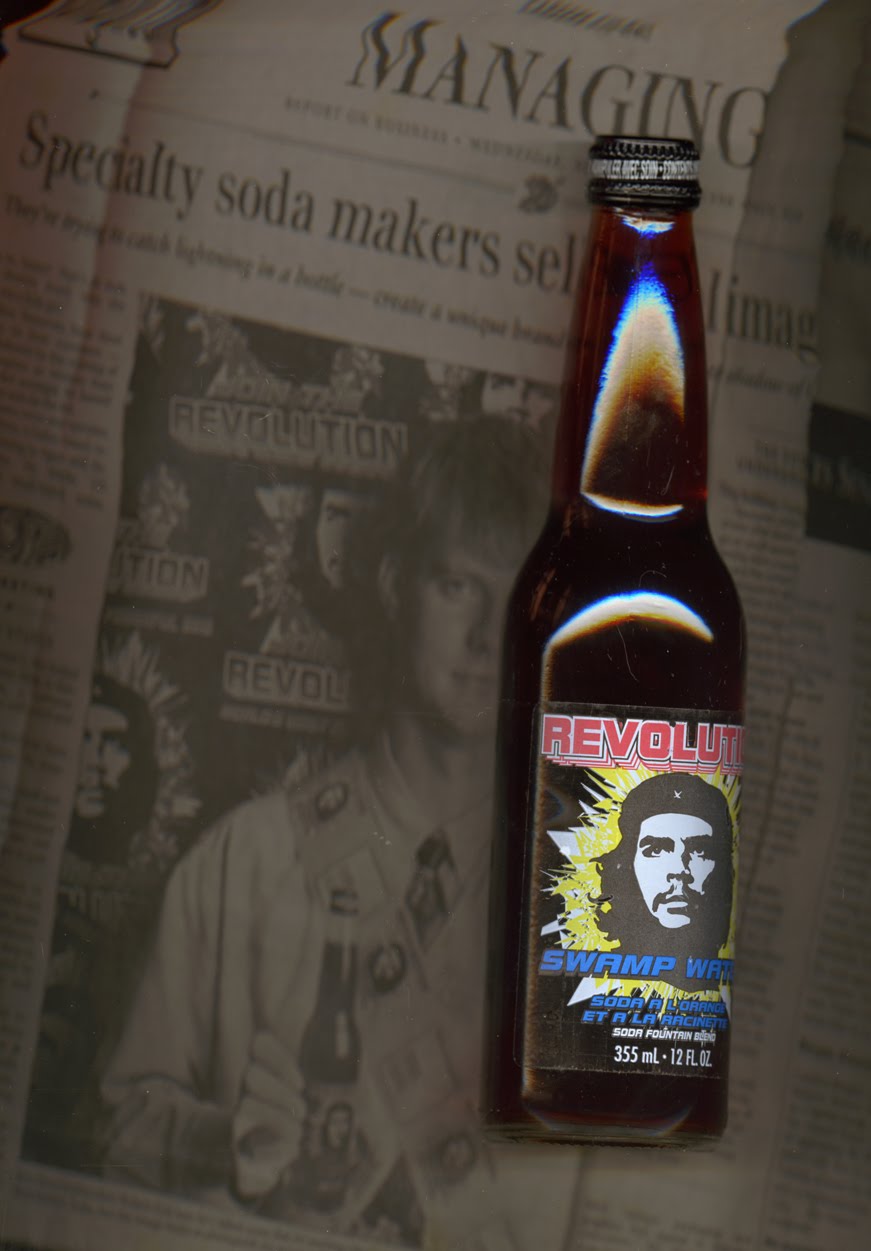
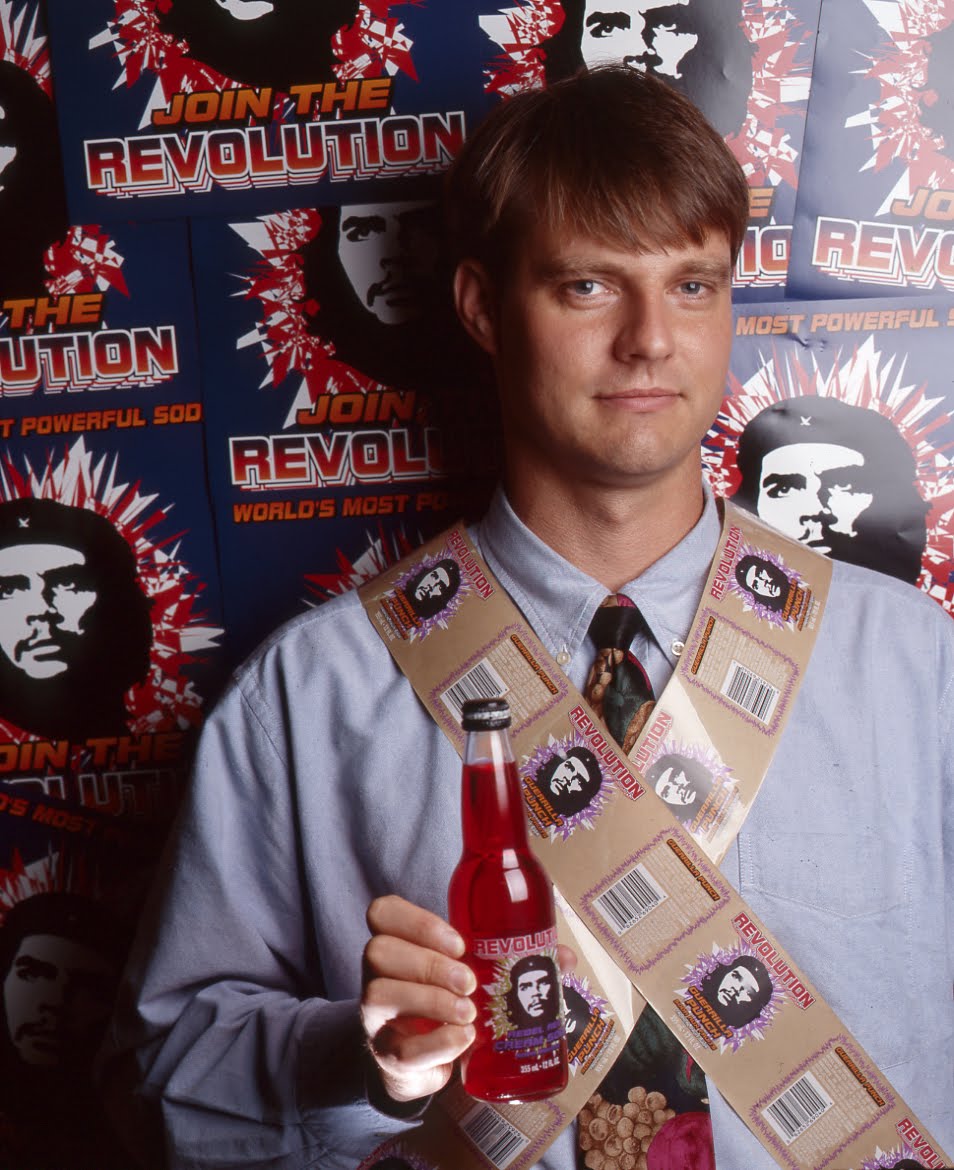
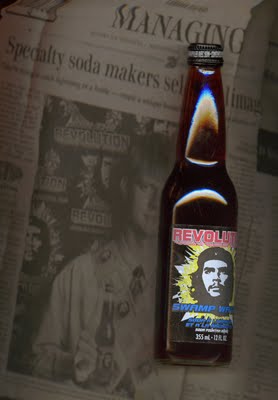
On September 1998 the Globe & Mail dispatched me to Langley to photograph Robert Kyle, the president of Bev-Source a beverage company. They had just launched a family of 6 drinks called Revolution with Che Guevara on the beautifully painted label. The promotion included T-shirts (I have two of them) and stickums. I have kept three bottles of my original 6 variety. They are as follows:
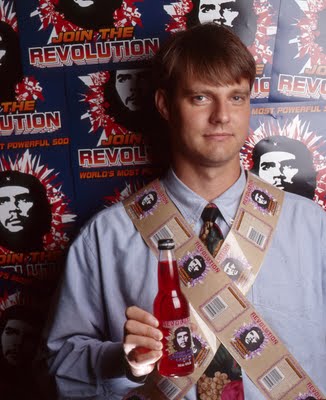
Sarsaparilla – Rootbeer with attitude
Brainwash Cola – High caffeine cola
Swamp Water – Soda Fountain Blend
While I don’t remember what the other three were I think one of them was a cream soda that had the name Rebel Red. They were good.
If I would tell any of you readers of this blog about the former existence of Revolution Cola, you would probably not believe me. But the pictures here are the proof.
Today Rosemary insisted on my going through my photo files from A to D. I was to read her names of people I might want to send my promotional postcards so that we can do a Lazarus on my photography business. It was during that search that I found the file Che Guevara Cola. There was another for which there is no room today. The file read Catch-It (Kitty Litter). Now I was dispatched by….
|